Milestone Achievement – Forbes India Select 200 DGEMS Recognizes WebDataGuru for Data Intelligence & AI-Driven Price Insights 🎉
Milestone Achievement – Forbes India Select 200 DGEMS Recognizes WebDataGuru for Data Intelligence & AI-Driven Price Insights 🎉
Milestone Achievement – Forbes India Select 200 DGEMS Recognizes WebDataGuru for Data Intelligence & AI-Driven Price Insights 🎉
Milestone Achievement – Forbes India Select 200 DGEMS Recognizes WebDataGuru for Data Intelligence & AI-Driven Price Insights 🎉
Milestone Achievement – Forbes India Select 200 DGEMS Recognizes WebDataGuru for Data Intelligence & AI-Driven Price Insights 🎉
Milestone Achievement – Forbes India Select 200 DGEMS Recognizes WebDataGuru for Data Intelligence & AI-Driven Price Insights 🎉
Milestone Achievement – Forbes India Select 200 DGEMS Recognizes WebDataGuru for Data Intelligence & AI-Driven Price Insights 🎉
Milestone Achievement – Forbes India Select 200 DGEMS Recognizes WebDataGuru for Data Intelligence & AI-Driven Price Insights 🎉
Milestone Achievement – Forbes India Select 200 DGEMS Recognizes WebDataGuru for Data Intelligence & AI-Driven Price Insights 🎉
Milestone Achievement – Forbes India Select 200 DGEMS Recognizes WebDataGuru for Data Intelligence & AI-Driven Price Insights 🎉
Milestone Achievement – Forbes India Select 200 DGEMS Recognizes WebDataGuru for Data Intelligence & AI-Driven Price Insights 🎉
Milestone Achievement – Forbes India Select 200 DGEMS Recognizes WebDataGuru for Data Intelligence & AI-Driven Price Insights 🎉
Milestone Achievement – Forbes India Select 200 DGEMS Recognizes WebDataGuru for Data Intelligence & AI-Driven Price Insights 🎉
Milestone Achievement – Forbes India Select 200 DGEMS Recognizes WebDataGuru for Data Intelligence & AI-Driven Price Insights 🎉
Milestone Achievement – Forbes India Select 200 DGEMS Recognizes WebDataGuru for Data Intelligence & AI-Driven Price Insights 🎉
Milestone Achievement – Forbes India Select 200 DGEMS Recognizes WebDataGuru for Data Intelligence & AI-Driven Price Insights 🎉
Milestone Achievement – Forbes India Select 200 DGEMS Recognizes WebDataGuru for Data Intelligence & AI-Driven Price Insights 🎉
Milestone Achievement – Forbes India Select 200 DGEMS Recognizes WebDataGuru for Data Intelligence & AI-Driven Price Insights 🎉
Milestone Achievement – Forbes India Select 200 DGEMS Recognizes WebDataGuru for Data Intelligence & AI-Driven Price Insights 🎉
Milestone Achievement – Forbes India Select 200 DGEMS Recognizes WebDataGuru for Data Intelligence & AI-Driven Price Insights 🎉
Milestone Achievement – Forbes India Select 200 DGEMS Recognizes WebDataGuru for Data Intelligence & AI-Driven Price Insights 🎉
Milestone Achievement – Forbes India Select 200 DGEMS Recognizes WebDataGuru for Data Intelligence & AI-Driven Price Insights 🎉
Milestone Achievement – Forbes India Select 200 DGEMS Recognizes WebDataGuru for Data Intelligence & AI-Driven Price Insights 🎉
Milestone Achievement – Forbes India Select 200 DGEMS Recognizes WebDataGuru for Data Intelligence & AI-Driven Price Insights 🎉
Milestone Achievement – Forbes India Select 200 DGEMS Recognizes WebDataGuru for Data Intelligence & AI-Driven Price Insights 🎉
Milestone Achievement – Forbes India Select 200 DGEMS Recognizes WebDataGuru for Data Intelligence & AI-Driven Price Insights 🎉
Milestone Achievement – Forbes India Select 200 DGEMS Recognizes WebDataGuru for Data Intelligence & AI-Driven Price Insights 🎉
Milestone Achievement – Forbes India Select 200 DGEMS Recognizes WebDataGuru for Data Intelligence & AI-Driven Price Insights 🎉
Milestone Achievement – Forbes India Select 200 DGEMS Recognizes WebDataGuru for Data Intelligence & AI-Driven Price Insights 🎉
Milestone Achievement – Forbes India Select 200 DGEMS Recognizes WebDataGuru for Data Intelligence & AI-Driven Price Insights 🎉
Milestone Achievement – Forbes India Select 200 DGEMS Recognizes WebDataGuru for Data Intelligence & AI-Driven Price Insights 🎉
Milestone Achievement – Forbes India Select 200 DGEMS Recognizes WebDataGuru for Data Intelligence & AI-Driven Price Insights 🎉
Milestone Achievement – Forbes India Select 200 DGEMS Recognizes WebDataGuru for Data Intelligence & AI-Driven Price Insights 🎉
Milestone Achievement – Forbes India Select 200 DGEMS Recognizes WebDataGuru for Data Intelligence & AI-Driven Price Insights 🎉
Milestone Achievement – Forbes India Select 200 DGEMS Recognizes WebDataGuru for Data Intelligence & AI-Driven Price Insights 🎉
Milestone Achievement – Forbes India Select 200 DGEMS Recognizes WebDataGuru for Data Intelligence & AI-Driven Price Insights 🎉
Milestone Achievement – Forbes India Select 200 DGEMS Recognizes WebDataGuru for Data Intelligence & AI-Driven Price Insights 🎉
Milestone Achievement – Forbes India Select 200 DGEMS Recognizes WebDataGuru for Data Intelligence & AI-Driven Price Insights 🎉
Milestone Achievement – Forbes India Select 200 DGEMS Recognizes WebDataGuru for Data Intelligence & AI-Driven Price Insights 🎉
Milestone Achievement – Forbes India Select 200 DGEMS Recognizes WebDataGuru for Data Intelligence & AI-Driven Price Insights 🎉
Milestone Achievement – Forbes India Select 200 DGEMS Recognizes WebDataGuru for Data Intelligence & AI-Driven Price Insights 🎉
Milestone Achievement – Forbes India Select 200 DGEMS Recognizes WebDataGuru for Data Intelligence & AI-Driven Price Insights 🎉
Milestone Achievement – Forbes India Select 200 DGEMS Recognizes WebDataGuru for Data Intelligence & AI-Driven Price Insights 🎉
Milestone Achievement – Forbes India Select 200 DGEMS Recognizes WebDataGuru for Data Intelligence & AI-Driven Price Insights 🎉
Milestone Achievement – Forbes India Select 200 DGEMS Recognizes WebDataGuru for Data Intelligence & AI-Driven Price Insights 🎉
Milestone Achievement – Forbes India Select 200 DGEMS Recognizes WebDataGuru for Data Intelligence & AI-Driven Price Insights 🎉
Milestone Achievement – Forbes India Select 200 DGEMS Recognizes WebDataGuru for Data Intelligence & AI-Driven Price Insights 🎉
Milestone Achievement – Forbes India Select 200 DGEMS Recognizes WebDataGuru for Data Intelligence & AI-Driven Price Insights 🎉
Milestone Achievement – Forbes India Select 200 DGEMS Recognizes WebDataGuru for Data Intelligence & AI-Driven Price Insights 🎉
Milestone Achievement – Forbes India Select 200 DGEMS Recognizes WebDataGuru for Data Intelligence & AI-Driven Price Insights 🎉
Milestone Achievement – Forbes India Select 200 DGEMS Recognizes WebDataGuru for Data Intelligence & AI-Driven Price Insights 🎉
Milestone Achievement – Forbes India Select 200 DGEMS Recognizes WebDataGuru for Data Intelligence & AI-Driven Price Insights 🎉
Milestone Achievement – Forbes India Select 200 DGEMS Recognizes WebDataGuru for Data Intelligence & AI-Driven Price Insights 🎉
Milestone Achievement – Forbes India Select 200 DGEMS Recognizes WebDataGuru for Data Intelligence & AI-Driven Price Insights 🎉
Milestone Achievement – Forbes India Select 200 DGEMS Recognizes WebDataGuru for Data Intelligence & AI-Driven Price Insights 🎉
Milestone Achievement – Forbes India Select 200 DGEMS Recognizes WebDataGuru for Data Intelligence & AI-Driven Price Insights 🎉
Milestone Achievement – Forbes India Select 200 DGEMS Recognizes WebDataGuru for Data Intelligence & AI-Driven Price Insights 🎉
Milestone Achievement – Forbes India Select 200 DGEMS Recognizes WebDataGuru for Data Intelligence & AI-Driven Price Insights 🎉
Milestone Achievement – Forbes India Select 200 DGEMS Recognizes WebDataGuru for Data Intelligence & AI-Driven Price Insights 🎉
Milestone Achievement – Forbes India Select 200 DGEMS Recognizes WebDataGuru for Data Intelligence & AI-Driven Price Insights 🎉
Milestone Achievement – Forbes India Select 200 DGEMS Recognizes WebDataGuru for Data Intelligence & AI-Driven Price Insights 🎉
Milestone Achievement – Forbes India Select 200 DGEMS Recognizes WebDataGuru for Data Intelligence & AI-Driven Price Insights 🎉
Milestone Achievement – Forbes India Select 200 DGEMS Recognizes WebDataGuru for Data Intelligence & AI-Driven Price Insights 🎉
Milestone Achievement – Forbes India Select 200 DGEMS Recognizes WebDataGuru for Data Intelligence & AI-Driven Price Insights 🎉
Milestone Achievement – Forbes India Select 200 DGEMS Recognizes WebDataGuru for Data Intelligence & AI-Driven Price Insights 🎉
Milestone Achievement – Forbes India Select 200 DGEMS Recognizes WebDataGuru for Data Intelligence & AI-Driven Price Insights 🎉
10 Best Priceva Alternatives & Competitors
Priceva has become a familiar name for ecommerce teams that want to keep an eye on competitor prices without hiring a full pricing department. It bundles monitoring, MAP alerts, and basic repricing into one dashboard, which is exactly why so many small and mid-size retailers start there.
But as catalogs grow past a few hundred SKUs, or as businesses expand into more marketplaces and countries, the cracks start to show. Product matching gets less accurate, support response times slow down, and some teams find the reporting too shallow to support real pricing decisions. If you're hitting any of these walls, you're not alone and you have options.
This guide breaks down the 10 best Priceva alternatives and competitors in 2026, covering what each tool does best, who it's built for, and where it falls short, so you can pick the right fit for your catalog size, budget, and goals.
1. PriceIntelGuru
Best for: Ecommerce & Retailers, brands, manufacturers, and marketplace sellers who want AI-driven price intelligence without manual SKU tracking.
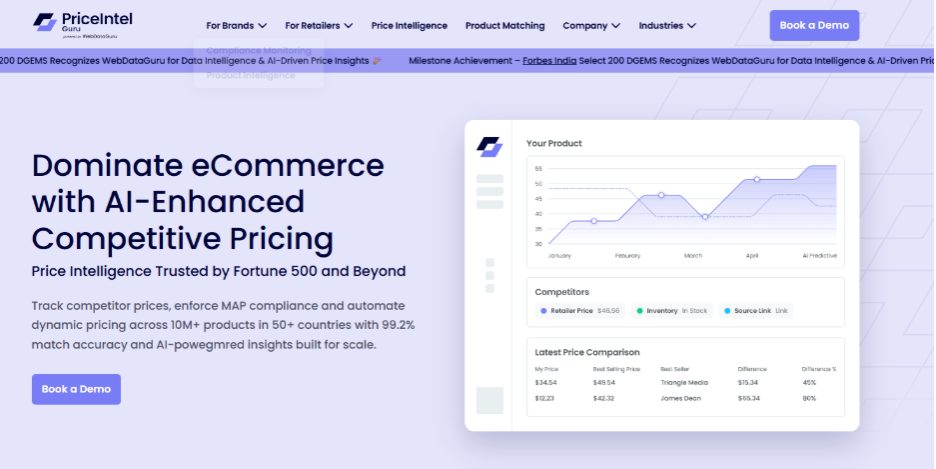
PriceIntelGuru, PriceIntelGuru, a flagship platform by WebDataGuru, is an AI-powered price intelligence, competitor price monitoring, product matching, MAP monitoring, and dynamic pricing platform built for retailers, eCommerce brands, manufacturers, distributors, marketplace sellers, and pricing teams. The platform helps businesses monitor competitor prices, track marketplace pricing, detect MAP violations, compare matched products, analyze stock availability, and automate pricing decisions from one easy-to-use dashboard.
With coverage across 10M+ products in 50+ countries and 99.2% AI-driven product match accuracy, PriceIntelGuru helps businesses reduce manual SKU tracking, replace spreadsheets, protect margins, improve pricing agility, and make faster data-backed pricing decisions.
Key strengths:
AI-powered product matching with 99.2% accuracy, reducing manual SKU verification
Competitor and marketplace price monitoring at scale (10M+ products, 50+ countries)
Built-in MAP violation detection and alerts to help protect brand pricing policies
Stock availability and dynamic pricing automation from one dashboard
Designed to replace spreadsheets and manual tracking entirely
Best fit: Ecommerce brands, retailers, manufacturers, and distributors that have outgrown basic monitoring tools and need accurate, large-scale competitor price monitoringtools with automation built in.
2. Prisync
Best for: Small to mid-size ecommerce stores on Shopify, Magento, or BigCommerce that want simple setup with no developer help.
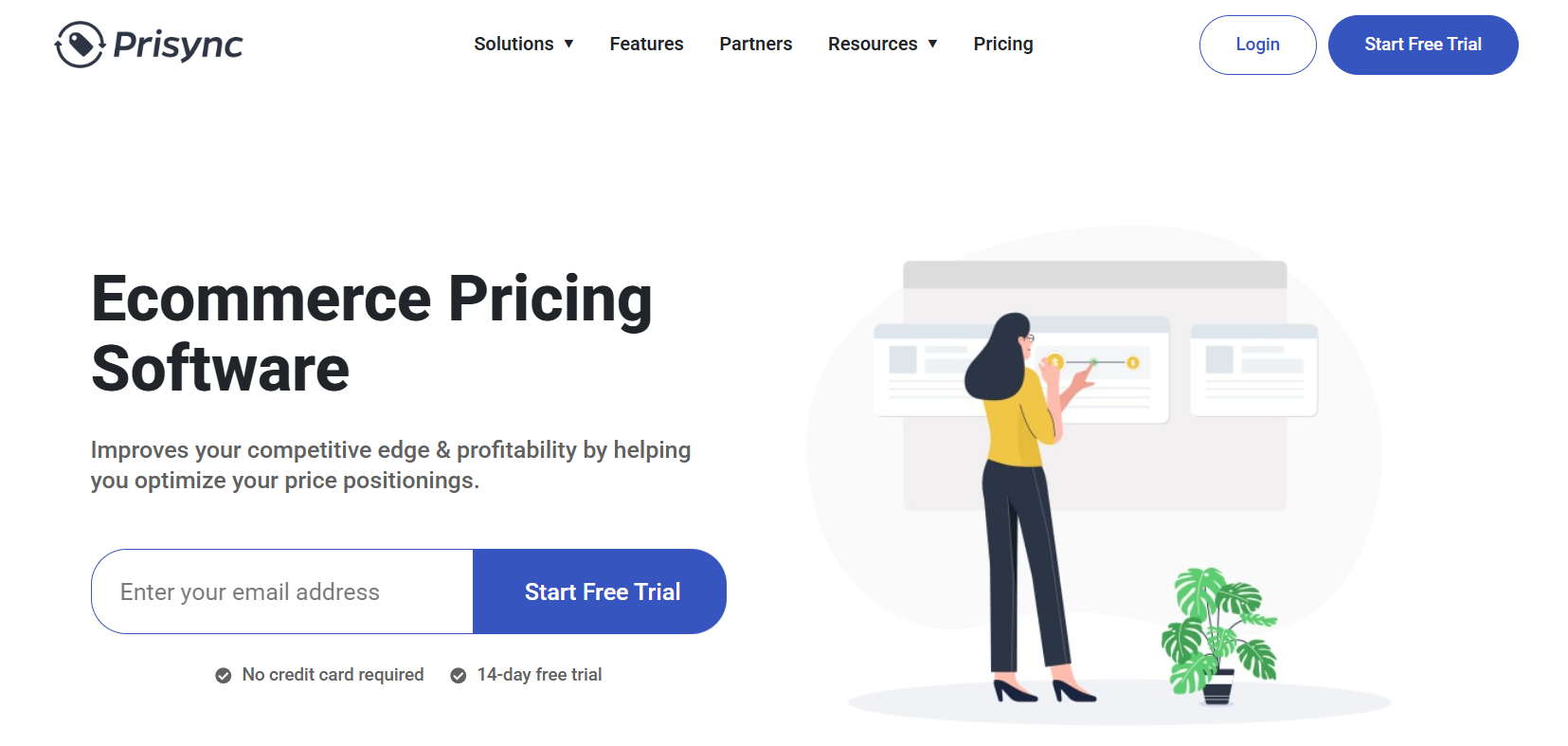
Prisync is one of the most widely used competitive pricing software options for smaller catalogs. It lets Shopify sellers track competitor prices instantly without APIs, complex integrations, or sales calls, and every plan includes dynamic pricing rules so businesses can automate price adjustments without paying for a separate repricing module.
Where it falls short: Pricing scales with the number of tracked products, so businesses with large catalogs often see costs rise quickly, and Prisync does not include built-in MAP violation monitoring, which can be a dealbreaker for brand-protection-focused teams.
3. Price2Spy
Best for: Mid-market brands that need high-frequency monitoring and MAP enforcement with timestamped evidence.
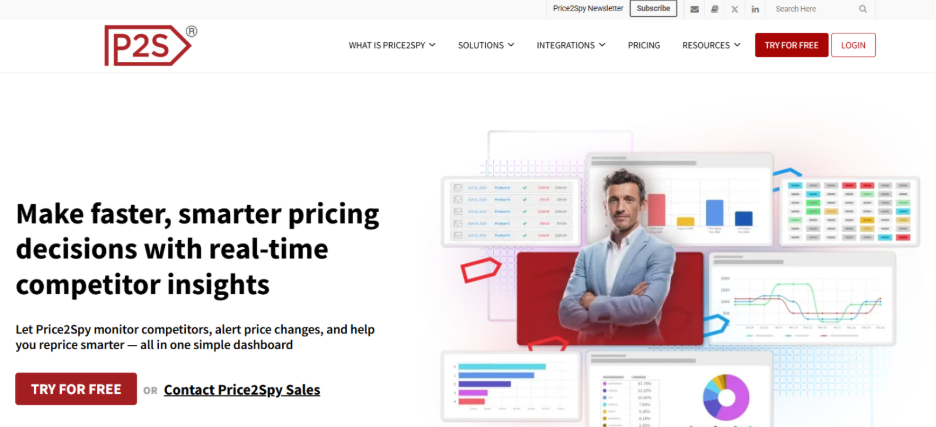
Price2Spy supports up to eight price checks per day, along with alerts and historical reporting, and it tracks additional data points like stock status, shipping costs, seller ratings, and review counts alongside price. This makes it a solid price intelligence software option for brands that need more than just a price number.
Where it falls short: Pricing is URL-based, so costs scale with the number of competitors tracked rather than products something to factor in if you monitor many sellers per SKU.
4. Competera
Best for: Enterprise retailers with dedicated pricing teams and the resources for a deeper AI implementation.
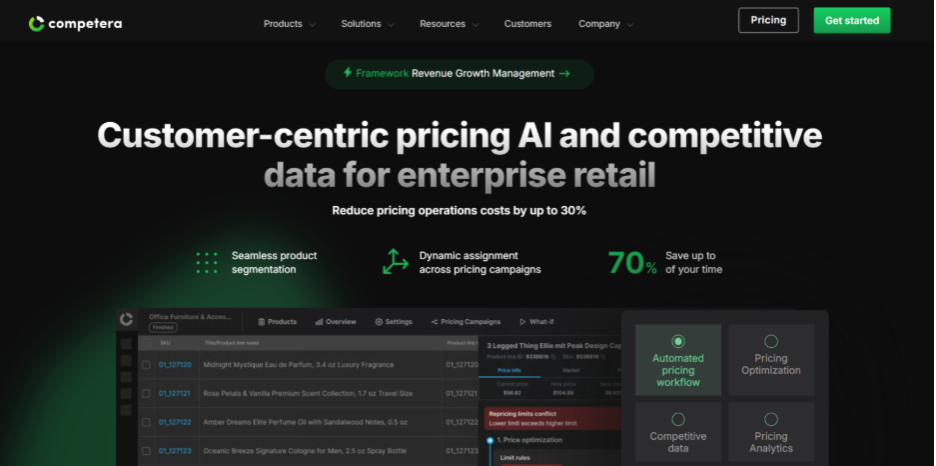
Competera leans heavily into AI pricing software territory. Its prediction layer and contextual AI analyze 20+ demand factors through hundreds of deep learning models, recommending prices at the SKU level.
Where it falls short: Results require weeks of ERP integration, AI model training, and a dedicated pricing team to execute, making it a heavier lift than most mid-market teams need.
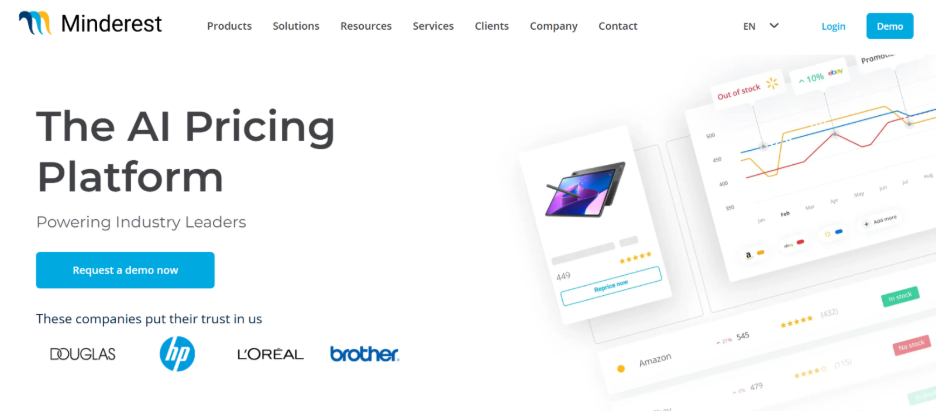
5. Minderest
Best for: Brands managing pricing across distributor networks, marketplaces, and international markets.
Minderest is built for global reach. It supports competitor price and stock tracking, price comparison, alerts, dashboards, and AI-powered product matching, and is especially useful for companies juggling multiple countries, languages, and currencies.
Where it falls short: Some users note the interface takes time to learn, and integrations beyond the API connector are more limited than fully native options.
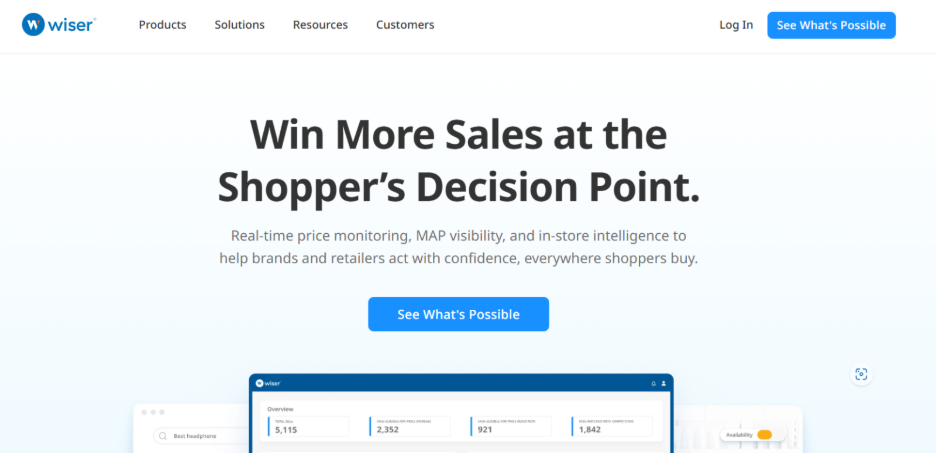
6. Wiser Solutions
Best for: Larger brands that need pricing data connected to retail execution and omnichannel visibility, including in-store.
Wiser stands out for scale and matching depth. It leads with 10B+ products and 200M+ prices monitored daily, with exact and equivalent item matching, including bundles and private label equivalents. It also offers notably long historical data retention compared to most tools in this space.
Where it falls short: Enterprise pricing and setup complexity can be more than smaller teams need, and onboarding typically requires more configuration time than lighter SaaS tools.
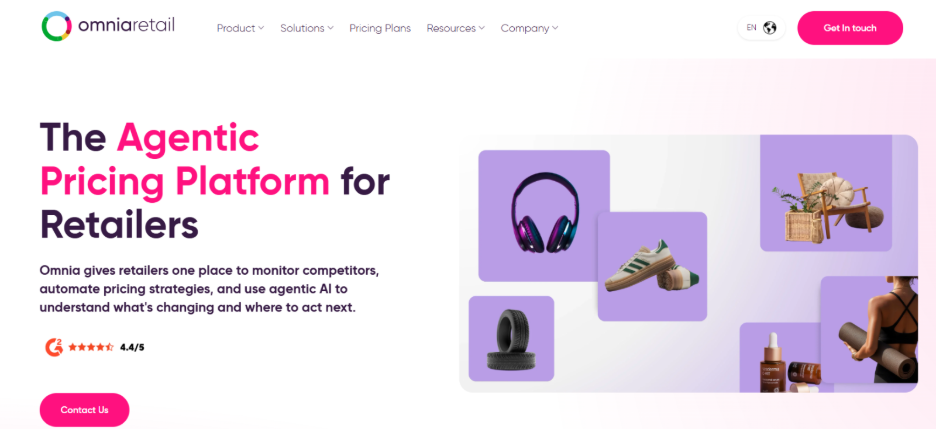
7. Omnia Retail
Best for: European retailers and brands looking for automated pricing strategy execution alongside monitoring.
Omnia Retail offers software that tracks and collects pricing data on competitors and resellers through scraping from comparison shopping engines, marketplaces, and direct online stores, paired with a "pricing tree" feature for building custom pricing rules.
Where it falls short: The platform needs training to use fully, and customizing or exploring data in depth can be limited compared to more analytics-heavy tools.
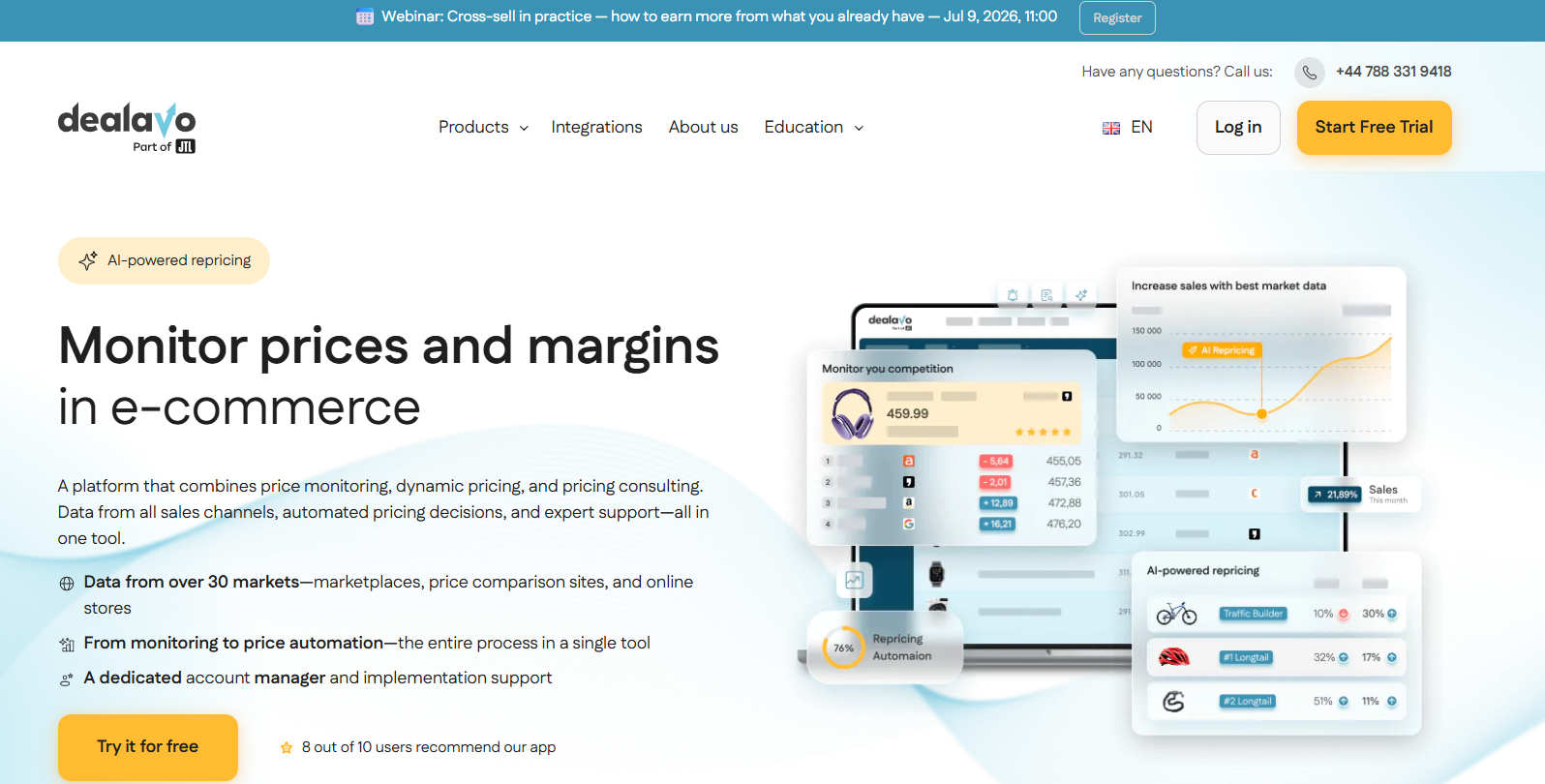
8. Dealavo
Best for: Brands where product-matching accuracy is non-negotiable, such as regulated or high-SKU-complexity categories.
Dealavo's standout feature is its human verification layer. Every match is verified by a human QA team before it reaches the dashboard, which appeals to brands where a single bad match could cause real pricing or compliance consequences.
Where it falls short: Manual QA adds reliability but can also mean slower turnaround compared to fully automated matching engines.
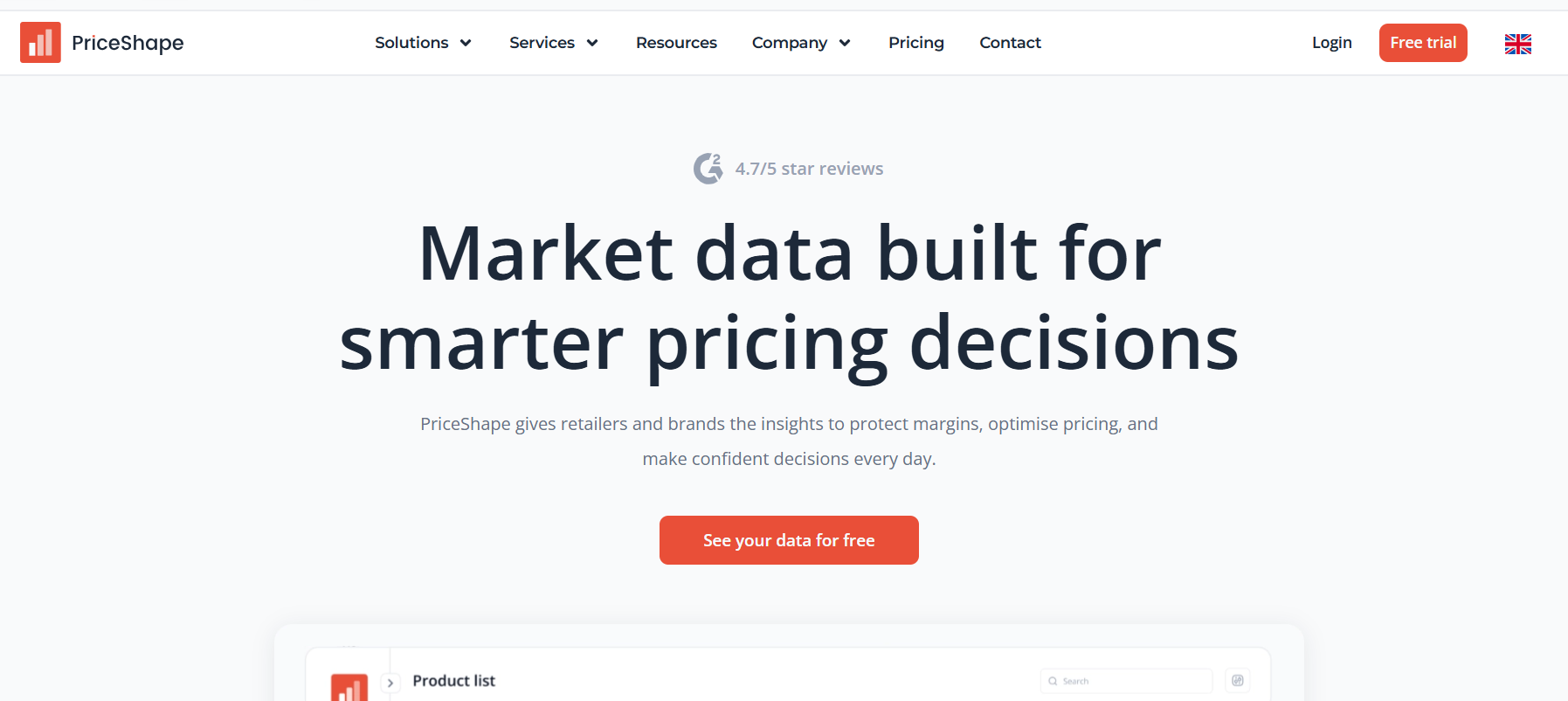
9. PriceShape
Best for: Retailers running Google Shopping campaigns who want pricing data tied directly to ad spend.
PriceShape connects pricing data to ad spend through a feed editor that inserts dynamic price tags into Google Shopping campaigns, helping budget concentrate on competitively priced products. It's a niche but useful pick for retailers whose pricing strategy is closely tied to paid search performance.
Where it falls short: This tight focus on Shopping feeds means it's less suited to teams that need to broader beyond Google's ecosystem.
10. NetRivals
Best for: Retailers and brands wanting real-time competitors and stock monitoring with AI-assisted matching.
NetRivals helps teams track competitor prices and stock in real time, monitor websites and marketplaces, identify pricing gaps, and support dynamic repricing, with AI-powered product matching baked in.
Where it falls short: As with many monitoring-first tools, deeper pricing optimization features often require add-ons or higher-tier plans.
Final Thoughts
Priceva works well for teams that need straightforward monitoring and repricing without separate add-on costs. But once your catalog, marketplace footprint, or accuracy requirements grow, a more capable pricing intelligence platform is usually the better for long-term investment.
For businesses managing large or fast-growing catalogs, PriceIntelGuru is worth a close look. With AI-driven product matching, MAP monitoring, stock visibility, and dynamic pricing automation built into one dashboard, it's designed to help pricing and ecommerce teams move away from manual SKU tracking and spreadsheets and toward faster, more confident pricing decisions.
Frequently Asked Questions
1. What is the best Priceva alternative for large catalogs?
Tools with strong AI-driven product matching at scale, such as PriceIntelGuru and Wiser Solutions, tend to perform best for large or fast-growing catalogs, since matching accuracy becomes more important as SKU count increases.
2. Do all Priceva alternatives include MAP monitoring?
No. MAP monitoring is included by default in some platforms, like PriceIntelGuru and Price2Spy, while others treat it as an add-on or don't offer it at all, such as Prisync.
3. Is dynamic pricing software the same as price monitoring software?
Not exactly. Price monitoring software collects competitor pricing data, while dynamic pricing software uses that data to automatically adjust your own prices based on rules or AI recommendations. Many modern platforms, including PriceIntelGuru, combine both functions in one system.
4. How much do Priceva alternatives typically cost?
Pricing varies widely by catalog size and feature set. Some tools start around $99/month for smaller catalogs, while enterprise-grade platforms with AI pricing optimization are typically custom-quoted based on SKU volume and complexity.
Transform Your Pricing Strategy Today
Thank you! Your submission has been received!
Oops! Something went wrong while submitting the form.