Milestone Achievement – Forbes India Select 200 DGEMS Recognizes WebDataGuru for Data Intelligence & AI-Driven Price Insights 🎉
Milestone Achievement – Forbes India Select 200 DGEMS Recognizes WebDataGuru for Data Intelligence & AI-Driven Price Insights 🎉
Milestone Achievement – Forbes India Select 200 DGEMS Recognizes WebDataGuru for Data Intelligence & AI-Driven Price Insights 🎉
Milestone Achievement – Forbes India Select 200 DGEMS Recognizes WebDataGuru for Data Intelligence & AI-Driven Price Insights 🎉
Milestone Achievement – Forbes India Select 200 DGEMS Recognizes WebDataGuru for Data Intelligence & AI-Driven Price Insights 🎉
Milestone Achievement – Forbes India Select 200 DGEMS Recognizes WebDataGuru for Data Intelligence & AI-Driven Price Insights 🎉
Milestone Achievement – Forbes India Select 200 DGEMS Recognizes WebDataGuru for Data Intelligence & AI-Driven Price Insights 🎉
Milestone Achievement – Forbes India Select 200 DGEMS Recognizes WebDataGuru for Data Intelligence & AI-Driven Price Insights 🎉
Milestone Achievement – Forbes India Select 200 DGEMS Recognizes WebDataGuru for Data Intelligence & AI-Driven Price Insights 🎉
Milestone Achievement – Forbes India Select 200 DGEMS Recognizes WebDataGuru for Data Intelligence & AI-Driven Price Insights 🎉
Milestone Achievement – Forbes India Select 200 DGEMS Recognizes WebDataGuru for Data Intelligence & AI-Driven Price Insights 🎉
Milestone Achievement – Forbes India Select 200 DGEMS Recognizes WebDataGuru for Data Intelligence & AI-Driven Price Insights 🎉
Milestone Achievement – Forbes India Select 200 DGEMS Recognizes WebDataGuru for Data Intelligence & AI-Driven Price Insights 🎉
Milestone Achievement – Forbes India Select 200 DGEMS Recognizes WebDataGuru for Data Intelligence & AI-Driven Price Insights 🎉
Milestone Achievement – Forbes India Select 200 DGEMS Recognizes WebDataGuru for Data Intelligence & AI-Driven Price Insights 🎉
Milestone Achievement – Forbes India Select 200 DGEMS Recognizes WebDataGuru for Data Intelligence & AI-Driven Price Insights 🎉
Milestone Achievement – Forbes India Select 200 DGEMS Recognizes WebDataGuru for Data Intelligence & AI-Driven Price Insights 🎉
Milestone Achievement – Forbes India Select 200 DGEMS Recognizes WebDataGuru for Data Intelligence & AI-Driven Price Insights 🎉
Milestone Achievement – Forbes India Select 200 DGEMS Recognizes WebDataGuru for Data Intelligence & AI-Driven Price Insights 🎉
Milestone Achievement – Forbes India Select 200 DGEMS Recognizes WebDataGuru for Data Intelligence & AI-Driven Price Insights 🎉
Milestone Achievement – Forbes India Select 200 DGEMS Recognizes WebDataGuru for Data Intelligence & AI-Driven Price Insights 🎉
Milestone Achievement – Forbes India Select 200 DGEMS Recognizes WebDataGuru for Data Intelligence & AI-Driven Price Insights 🎉
Milestone Achievement – Forbes India Select 200 DGEMS Recognizes WebDataGuru for Data Intelligence & AI-Driven Price Insights 🎉
Milestone Achievement – Forbes India Select 200 DGEMS Recognizes WebDataGuru for Data Intelligence & AI-Driven Price Insights 🎉
Milestone Achievement – Forbes India Select 200 DGEMS Recognizes WebDataGuru for Data Intelligence & AI-Driven Price Insights 🎉
Milestone Achievement – Forbes India Select 200 DGEMS Recognizes WebDataGuru for Data Intelligence & AI-Driven Price Insights 🎉
Milestone Achievement – Forbes India Select 200 DGEMS Recognizes WebDataGuru for Data Intelligence & AI-Driven Price Insights 🎉
Milestone Achievement – Forbes India Select 200 DGEMS Recognizes WebDataGuru for Data Intelligence & AI-Driven Price Insights 🎉
Milestone Achievement – Forbes India Select 200 DGEMS Recognizes WebDataGuru for Data Intelligence & AI-Driven Price Insights 🎉
Milestone Achievement – Forbes India Select 200 DGEMS Recognizes WebDataGuru for Data Intelligence & AI-Driven Price Insights 🎉
Milestone Achievement – Forbes India Select 200 DGEMS Recognizes WebDataGuru for Data Intelligence & AI-Driven Price Insights 🎉
Milestone Achievement – Forbes India Select 200 DGEMS Recognizes WebDataGuru for Data Intelligence & AI-Driven Price Insights 🎉
Milestone Achievement – Forbes India Select 200 DGEMS Recognizes WebDataGuru for Data Intelligence & AI-Driven Price Insights 🎉
Milestone Achievement – Forbes India Select 200 DGEMS Recognizes WebDataGuru for Data Intelligence & AI-Driven Price Insights 🎉
Milestone Achievement – Forbes India Select 200 DGEMS Recognizes WebDataGuru for Data Intelligence & AI-Driven Price Insights 🎉
Milestone Achievement – Forbes India Select 200 DGEMS Recognizes WebDataGuru for Data Intelligence & AI-Driven Price Insights 🎉
Milestone Achievement – Forbes India Select 200 DGEMS Recognizes WebDataGuru for Data Intelligence & AI-Driven Price Insights 🎉
Milestone Achievement – Forbes India Select 200 DGEMS Recognizes WebDataGuru for Data Intelligence & AI-Driven Price Insights 🎉
Milestone Achievement – Forbes India Select 200 DGEMS Recognizes WebDataGuru for Data Intelligence & AI-Driven Price Insights 🎉
Milestone Achievement – Forbes India Select 200 DGEMS Recognizes WebDataGuru for Data Intelligence & AI-Driven Price Insights 🎉
Milestone Achievement – Forbes India Select 200 DGEMS Recognizes WebDataGuru for Data Intelligence & AI-Driven Price Insights 🎉
Milestone Achievement – Forbes India Select 200 DGEMS Recognizes WebDataGuru for Data Intelligence & AI-Driven Price Insights 🎉
Milestone Achievement – Forbes India Select 200 DGEMS Recognizes WebDataGuru for Data Intelligence & AI-Driven Price Insights 🎉
Milestone Achievement – Forbes India Select 200 DGEMS Recognizes WebDataGuru for Data Intelligence & AI-Driven Price Insights 🎉
Milestone Achievement – Forbes India Select 200 DGEMS Recognizes WebDataGuru for Data Intelligence & AI-Driven Price Insights 🎉
Milestone Achievement – Forbes India Select 200 DGEMS Recognizes WebDataGuru for Data Intelligence & AI-Driven Price Insights 🎉
Milestone Achievement – Forbes India Select 200 DGEMS Recognizes WebDataGuru for Data Intelligence & AI-Driven Price Insights 🎉
Milestone Achievement – Forbes India Select 200 DGEMS Recognizes WebDataGuru for Data Intelligence & AI-Driven Price Insights 🎉
Milestone Achievement – Forbes India Select 200 DGEMS Recognizes WebDataGuru for Data Intelligence & AI-Driven Price Insights 🎉
Milestone Achievement – Forbes India Select 200 DGEMS Recognizes WebDataGuru for Data Intelligence & AI-Driven Price Insights 🎉
Milestone Achievement – Forbes India Select 200 DGEMS Recognizes WebDataGuru for Data Intelligence & AI-Driven Price Insights 🎉
Milestone Achievement – Forbes India Select 200 DGEMS Recognizes WebDataGuru for Data Intelligence & AI-Driven Price Insights 🎉
Milestone Achievement – Forbes India Select 200 DGEMS Recognizes WebDataGuru for Data Intelligence & AI-Driven Price Insights 🎉
Milestone Achievement – Forbes India Select 200 DGEMS Recognizes WebDataGuru for Data Intelligence & AI-Driven Price Insights 🎉
Milestone Achievement – Forbes India Select 200 DGEMS Recognizes WebDataGuru for Data Intelligence & AI-Driven Price Insights 🎉
Milestone Achievement – Forbes India Select 200 DGEMS Recognizes WebDataGuru for Data Intelligence & AI-Driven Price Insights 🎉
Milestone Achievement – Forbes India Select 200 DGEMS Recognizes WebDataGuru for Data Intelligence & AI-Driven Price Insights 🎉
Milestone Achievement – Forbes India Select 200 DGEMS Recognizes WebDataGuru for Data Intelligence & AI-Driven Price Insights 🎉
Milestone Achievement – Forbes India Select 200 DGEMS Recognizes WebDataGuru for Data Intelligence & AI-Driven Price Insights 🎉
Milestone Achievement – Forbes India Select 200 DGEMS Recognizes WebDataGuru for Data Intelligence & AI-Driven Price Insights 🎉
Milestone Achievement – Forbes India Select 200 DGEMS Recognizes WebDataGuru for Data Intelligence & AI-Driven Price Insights 🎉
Milestone Achievement – Forbes India Select 200 DGEMS Recognizes WebDataGuru for Data Intelligence & AI-Driven Price Insights 🎉
Milestone Achievement – Forbes India Select 200 DGEMS Recognizes WebDataGuru for Data Intelligence & AI-Driven Price Insights 🎉
Milestone Achievement – Forbes India Select 200 DGEMS Recognizes WebDataGuru for Data Intelligence & AI-Driven Price Insights 🎉
Milestone Achievement – Forbes India Select 200 DGEMS Recognizes WebDataGuru for Data Intelligence & AI-Driven Price Insights 🎉
Milestone Achievement – Forbes India Select 200 DGEMS Recognizes WebDataGuru for Data Intelligence & AI-Driven Price Insights 🎉
Top 10 Prisync Alternatives & Competitors
If you've outgrown Prisync's product tiers, hit the 20% API surcharge, or just need more than basic URL-based tracking, you're not alone. Plenty of retailers and brands start with Prisync, then look for something that matches their catalog size, budget, or feature needs more closely.
This guide breaks down the 10 top Prisync alternatives and competitors for 2026 comparing features, pricing, and ideal use cases so you can find the platform that fits your catalog size and pricing strategy.
Quick Comparison: Best Prisync Alternatives & Competitors
Tool
Best For
Notable Strength
PriceIntelGuru
Ecommerce and retailer brands,
Manufacturers and distributors,
Automotive, Industrial parts, CPG,
Travel & tourism
99.2% product match accuracy,
10M+ products tracked
Price2Spy
MAP monitoring and repricing
Screenshot-based MAP violation evidence
Minderest
Brand-side MAP/MSRP enforcement
Online + offline channel coverage
Competera
Enterprise demand-based pricing
AI elasticity modeling
Pricefx
B2B manufacturers and distributors
CPQ plus pricing optimization
Wiser
Commerce execution at retail scale
In-store and online intelligence
PriceMole
Shopify/WooCommerce store owners
Native platform repricing
Boardfy
European marketplace sellers
400+ repricing variables
Pricefy
Small to mid-size retailers
Free entry tier
Omnia Retail
Mid-market dynamic pricing
Amazon and Google Shopping focus
Below, we'll go deeper into what each platform does well, who it's built for, and where it falls short, so you can pick the right fit instead of guessing.
1. PriceIntelGuru Best AI-Powered Price Intelligence Platform
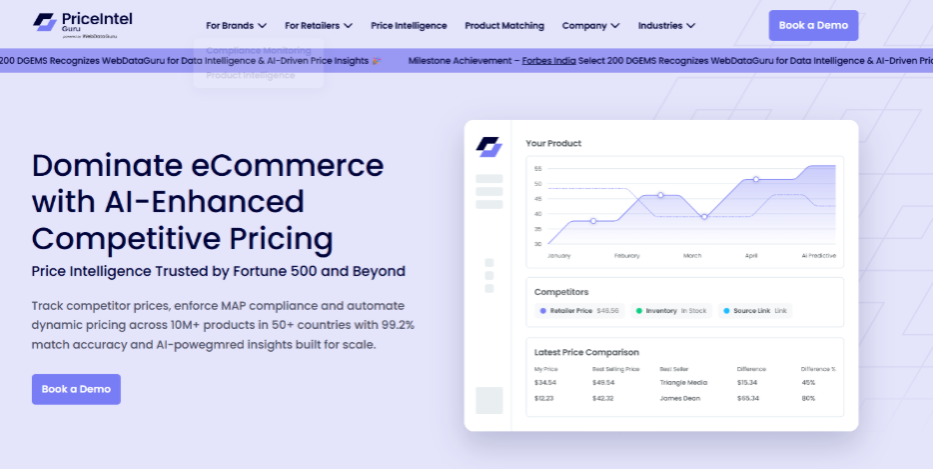
PriceIntelGuru, a flagship platform by WebDataGuru, is an AI-powered price intelligence, competitor price monitoring, product matching, MAP monitoring, and dynamic pricing platform built for retailers, eCommerce brands, manufacturers, distributors, marketplace sellers, and pricing teams. The platform helps businesses monitor competitor prices, track marketplace pricing, detect MAP violations, compare matched products, analyze stock availability, and automate pricing decisions from one easy-to-use dashboard.
With coverage across 10M+ products in 50+ countries and 99.2% AI-driven product match accuracy, PriceIntelGuru helps businesses reduce manual SKU tracking, replace spreadsheets, protect margins, improve pricing agility, and make faster data-backed pricing decisions.
Key features:
AI-powered competitor price monitoring across websites and marketplaces
Automated product matching with 99.2% AI-driven match accuracy
MAP (Minimum Advertised Price) violation detection and alerts
Stock and availability tracking alongside pricing data
Dynamic pricing automation from a single dashboard
Coverage across 10M+ products in 50+ countries
Best for: Retailers, brands, manufacturers, and marketplace sellers who want to replace spreadsheets and manual SKU tracking with an automated, data-backed pricing workflow that scales as the catalog grows.
Why it stands out as a Prisync alternative: Prisync's pricing tiers create awkward jumps between 100, 1,000, and 5,000 products, and dynamic repricing is gated behind higher tiers. PriceIntelGuru is built to remove that friction pairing AI product matching, MAP monitoring and pricing automation in one place, so pricing teams aren't stitching together multiple tools to get a complete view of the market.
2. Price2Spy
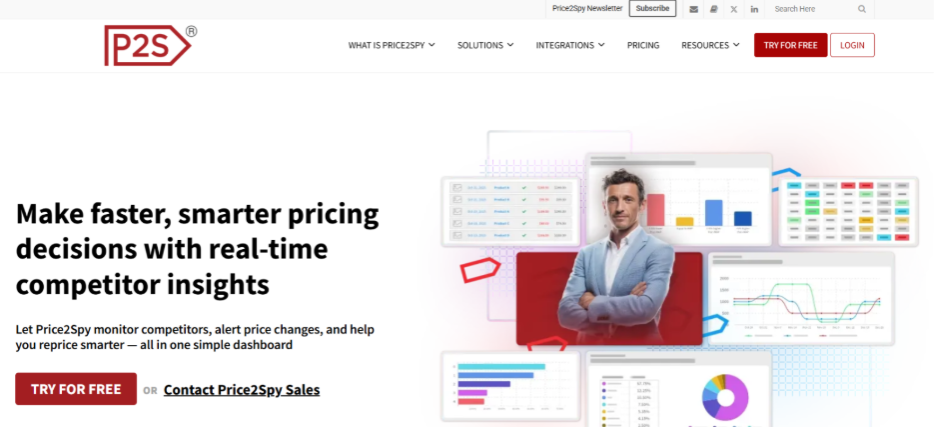
Price2Spy is one of the more established names in competitor price tracking, operating since 2010, across 40+ countries. It's built for mid-market enterprise retailers and brands that need monitoring, repricing, and MAP enforcement in a single system rather than three separate tools.
Key features:
Price checks up to 8 times per day on higher plans
Repricing module with configurable pricing rules
MAP monitoring with screenshot evidence for violations
Automatch for competitor product matching
25+ built-in pricing reports
Pros: Covers monitoring, repricing, MAP enforcement, and analytics on one platform; long track record and strong customer support reputation.
Cons: URL-based pricing structure can get confusing at scale tracking one product across five competitor sites counts as five separate URLs, which adds quickly. Premium plans can run into hundreds of dollars per month.
Best for: Brands and retailers that specifically need MAP enforcement with documented evidence of violations.
3. Minderest
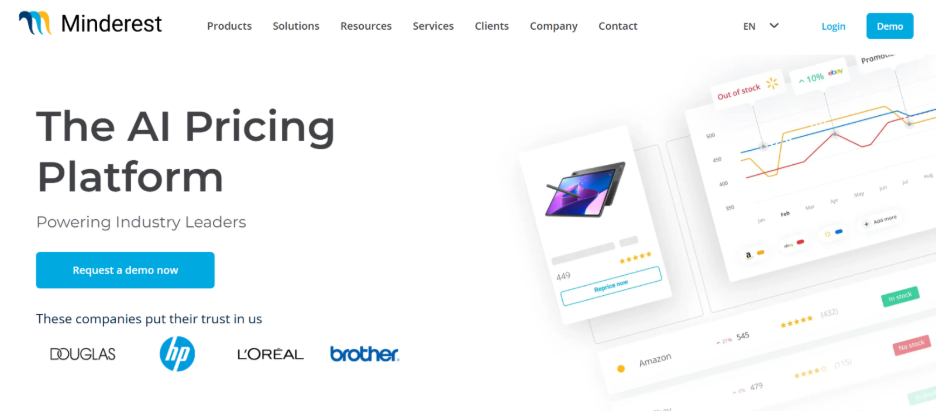
Minderest approaches brand and manufacturer side rather than the retailer side. Instead of just watching what competitors charge, it focuses on whether your own retailers and distributors are complying with your pricing policies.
Key features:
MAP and MSRP monitoring across retailer and distributor networks
Competitor tracking across websites, marketplaces, and offline channels
Multi-country and multi-currency support
Catalog intelligence with assortment and stock analysis
Pros: Strong specialization in brand-side pricing compliance; covers both online and offline retail channels, which most pure price trackers don't.
Cons: No public pricing, so budgeting requires a sales conversation; the setup tends to lean enterprise in complexity.
Best for: Manufacturers and brands that need to police MAP/MSRP compliance across a distributor network rather than just track market prices.
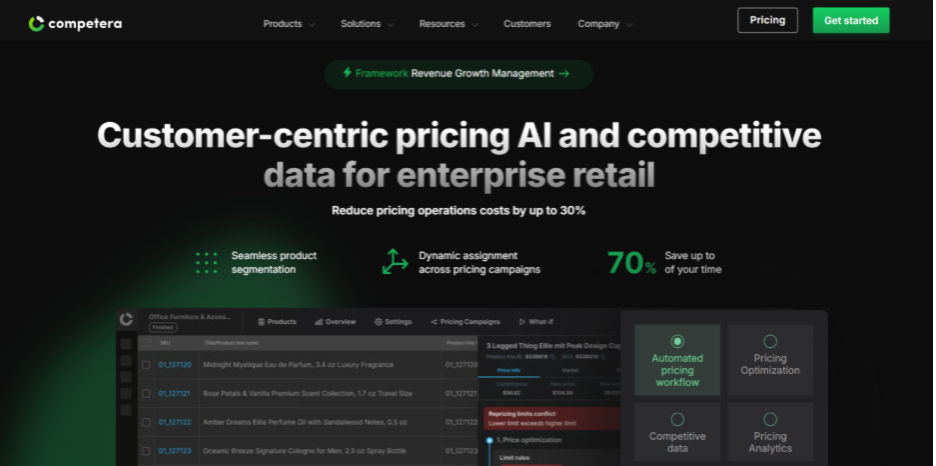
4. Competera
Competera moves beyond simple price tracking into AI-driven dynamic pricing territory. Instead of rule-based repricing ("match the lowest competitor"), it uses machine learning to model demand elasticity and recommend prices designed to optimize margin and conversion simultaneously.
Key features:
AI-driven price optimization based on demand elasticity
Scenario modeling to test pricing changes before rollout
Multi-category pricing strategy support
Market intelligence layered with assortment tracking
Pros: Goes well beyond what Prisync or most SME-focused tools offer; scenario modeling reduces the risk of a bad pricing decision before it hits the live catalog.
Cons: Pricing is custom and enterprise-oriented, so it's generally out of reach for smaller retailers; requires real setup time and internal resources to get value from it.
Best for: Large retailers running complex, multi-category pricing strategies who are ready to move past rule-based repricing.
5. Pricefx
Pricefx isn't really competing with Prisync in the same category; it's a full pricing optimization suite built for B2B manufacturers, distributors, and large retailers that need end-to-end price management, not just competitor monitoring.
Key features:
AI pricing agents for margin recovery and revenue optimization
CPQ (Configure, Price, Quote) for complex B2B deal management
Competitor price tracking folded into a broader pricing workflow
ERP and CRM integrations (SAP, Salesforce, and others)
Pros: Covers the full pricing lifecycle from market analysis to quote generation; cloud-native with faster deployment than older legacy pricing systems.
Cons: Custom pricing only, built for enterprise budgets; usually needs implementation support to configure properly.
Best for: B2B manufacturers and distributors where competitor pricing is just one input into a much larger quoting and margin strategy.
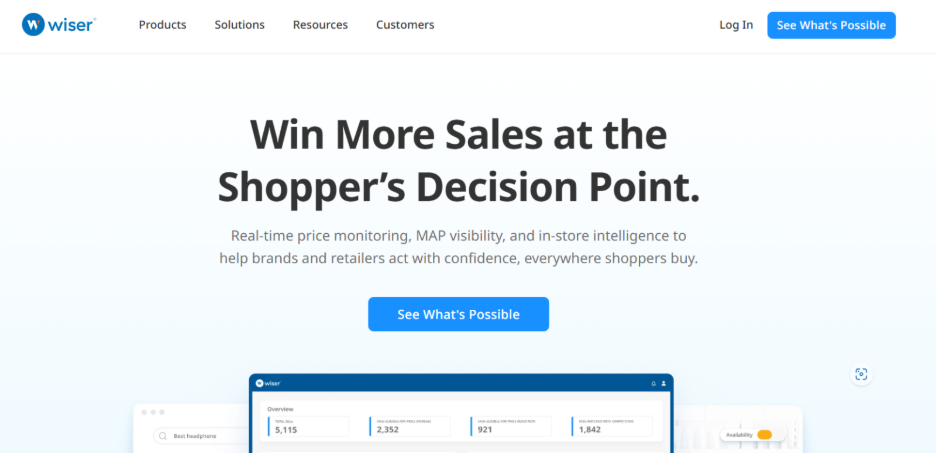
6. Wiser
Wiser positions itself in the "Commerce Execution" space a step beyond pure price intelligence into actionable insights that span both online and in-store pricing.
Key features:
Online and in-store competitive pricing data
Dynamic pricing recommendations for demand spikes or margin shrinkage
Retail execution analytics for brands and retailers
Image recognition for in-store price and shelf monitoring
Pros: Useful for businesses with both eCommerce and physical retail footprints; dynamic pricing logic adapts to demand shifts like post-holiday drops or new-product launches.
Cons: Can feel overkill for smaller, online-only sellers; pricing isn't published and tends to sit at a higher price point overall.
Best for: Retailers and brands that need pricing intelligence across both digital and physical storefronts.
7. PriceMole
PriceMole is built specifically for Shopify, BigCommerce, and WooCommerce store owners. Instead of a separate dashboard, it lives inside your existing store admin and applies repricing rules directly to your live listings.
Key features:
Native integrations with Shopify, BigCommerce, and WooCommerce
AI automatching to identify and link competitor products
Front-end price comparison widget for shoppers
Pros: No separate tool or login to manage; repricing updates apply in real time to your actual storefront; pricing is all-inclusive without add-on surcharges.
Cons: Limited to the eCommerce platforms it supports; some manual setup is still required for SKU-to-URL matching.
Best for: Shopify, BigCommerce, or WooCommerce merchants who want repricing built into their existing store admin rather than a standalone platform.
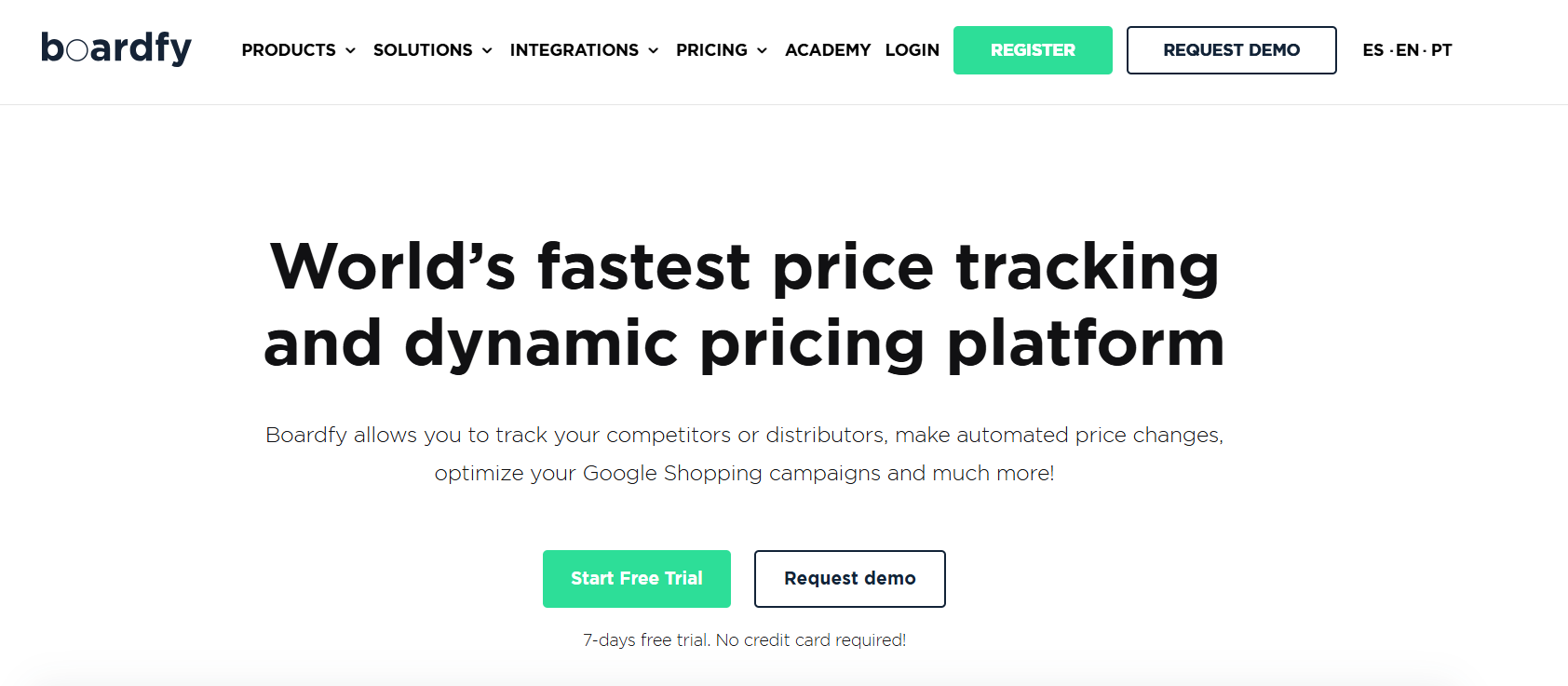
8. Boardfy
Boardfy is a European-focused marketplace monitoring and dynamic repricing platform built for multi-channel sellers operating across Amazon, eBay, Google Shopping, and Idealo.
Key features:
Multi-marketplace competitor monitoring across major European channels
AI-powered repricing that factors in 400+ pricing variables
MSRP violation detection for brand monitoring
CMS integrations with Shopify, Magento, and PrestaShop
Pros: Strong European marketplace coverage that's harder to find elsewhere; repricing logic accounts for far more than just the lowest competitor price.
Cons: Pricing isn't publicly listed; the depth of variables and configuration can feel more than smaller sellers need.
Best for: European eCommerce sellers running active campaigns across multiple marketplaces who want repricing automation, not just alerts.
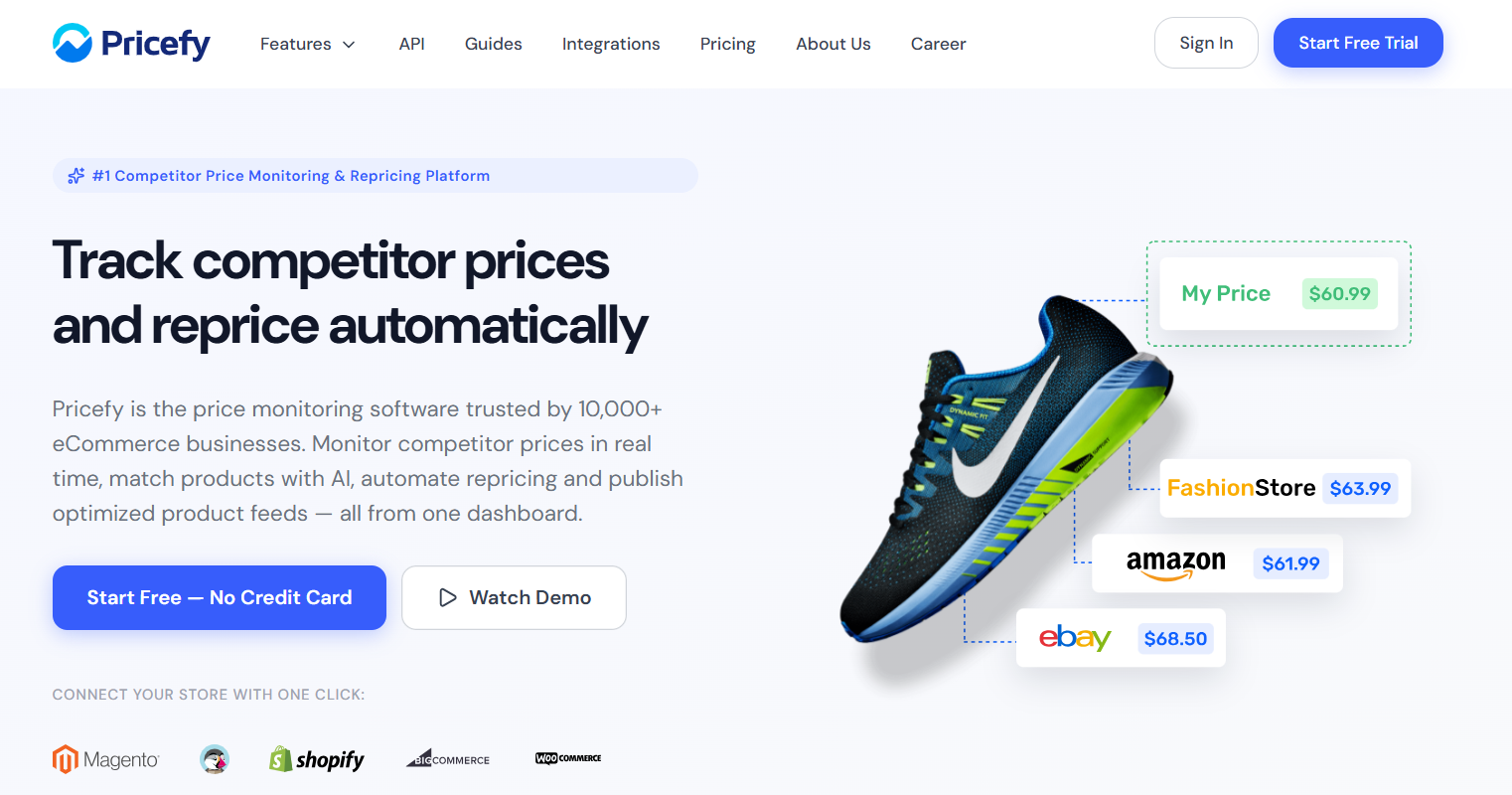
9. Pricefy
Pricefy is one of the more accessible entry points for smaller teams comparing competitor monitoring tools, largely because of its free tier and straightforward setup.
Key features:
Competitor price tracking across websites and marketplaces
Google Shopping integration
Automated and manual product matching
Repricing simulator to preview strategy changes before applying them
Pros: Free plan available for smaller catalogs; clean, easy-to-navigate interface; marketplace monitoring included even at the base paid tier.
Cons: Advanced analytics and brand-side reporting are less developed than enterprise tools; competitor count can be capped on lower-priced plans.
Best for: Small to mid-size retailers who want core competitor tracking without committing to an enterprise contract.
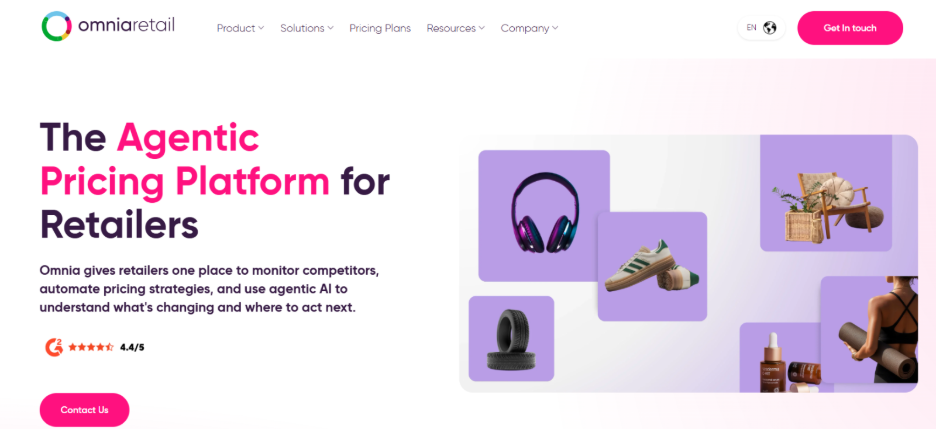
10. Omnia Retail
Omnia Retail rounds out the list as a pricing platform focused on aggregating data from major channels like Amazon and Google Shopping into a single pricing strategy dashboard.
Key features:
Price monitoring aggregated across Amazon, Google Shopping, and direct competitor sites
Market analysis paired with dynamic pricing rules
Strategy dashboard for implementing pricing changes
Automated price updates designed to help smaller retailers compete on speed
Pros: Reliable performance for mid-sized catalogs; dynamic pricing has been reported to help smaller retailers lift sales by reacting faster than manual pricing allows.
Cons: Can struggle with very large catalogs (50,000+ SKUs); some users find it doesn't scale smoothly as the business grows significantly.
Best for: Mid-market retailers focused heavily on Amazon and Google Shopping who want dynamic pricing without enterprise complexity.
How to Choose the Right Prisync Alternative
1. How big is your product catalog?
A few hundred SKUs → a lighter, lower-cost tool is probably enough.
Thousands of SKUs across multiple countries → you need a platform built for scale and matching accuracy, since manually verifying competitor matches stops being realistic at that volume.
2. Do you just need data, or do you need action?
Some tools only show you what competitors are charging.
Others go further automatically adjusting your prices, catching MAP violations with evidence, or flagging stock-outs in real time.
If you're spending time acting on alerts manually, look for a tool that automates that step.
3. Are you a retailer or a brand?
Retailers usually care about competitor price visibility, so they can stay competitive on their own listings.
Brands and manufacturers usually care about MAP/MSRP enforcement, so resellers don't undercut pricing policy.
These are different jobs to pick up a tool built for the one that matches your situation.
Final Thoughts
Prisync works fine for straightforward, smaller-scale competitor tracking. But once your catalog grows, your need for MAP enforcement increases, or you want pricing decisions automated rather than just reported; the right alternative depends on which of those problems you're solving.
For businesses that want AI-driven accuracy, broad marketplace and country coverage, and a single dashboard that handles monitoring, MAP compliance, and dynamic pricing together, PriceIntelGuru is built to cover that ground without forcing you to stitch together multiple tools or keep wrestling with spreadsheets.
Frequently Asked Questions
1. What is the best Prisync alternative for AI-driven price intelligence?
PriceIntelGuru is built specifically around AI-powered product matching and price intelligence, with 99.2% match accuracy across more than 10 million products in 50+ countries making it a strong fit for businesses that need accuracy at scale rather than basic URL tracking.
2. What's the difference between price monitoring software and dynamic pricing software?
Price monitoring software tracks what competitors charge and alert you to changes. Dynamic pricing software goes a step further by automatically adjusting your own prices based on rules or AI models, often using the monitoring data as an input.
3. Do I need a separate tool for MAP monitoring?
Not necessarily. Some platforms, including PriceIntelGuru, Price2Spy, and Minderest, combine MAP violation detection with general competitor price monitoring, so brands don't need to run a separate enforcement tool alongside their pricing intelligence platform.
4. Are Prisync alternatives more affordable than Prisync itself?
It varies. Tools like Pricefy and PriceMole offer lower entry costs, while enterprise-focused platforms like Competera and Pricefx are typically more expensive than Prisync. Pricing usually scales with catalog size and the depth of automation you need.
Transform Your Pricing Strategy Today
Thank you! Your submission has been received!
Oops! Something went wrong while submitting the form.