


.png)
.png)


© 2025 PriceIntelGuru. All Rights Reserved
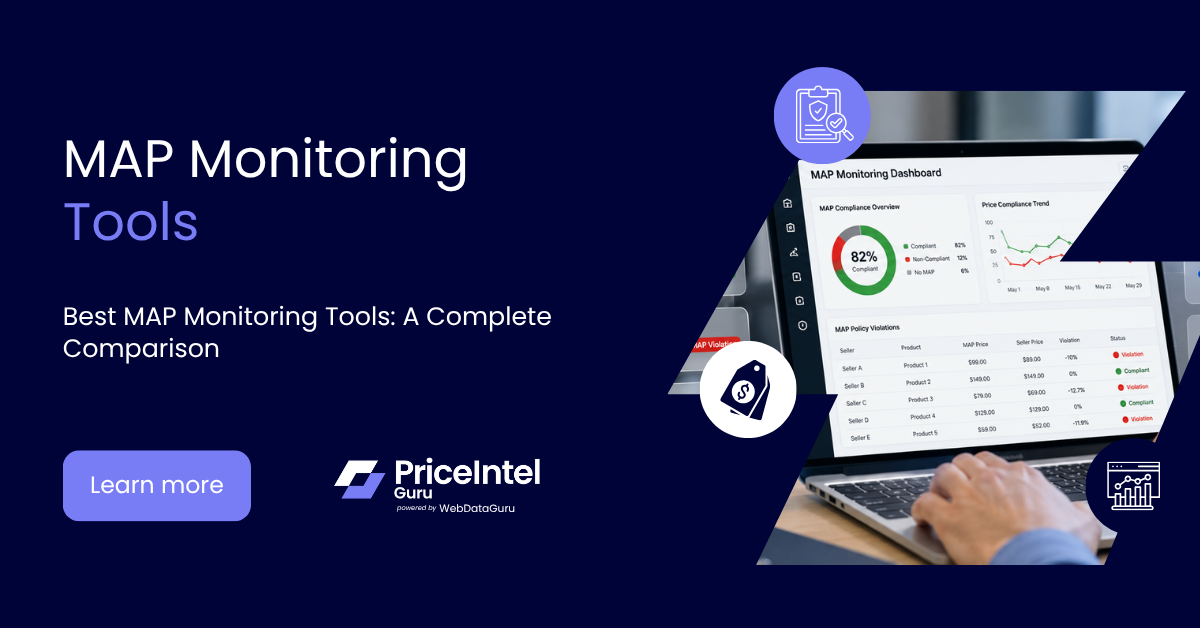
MAP monitoring tools are software platforms that track how retailers and resellers advertise a brand's products online, flagging any price shown below the brand's minimum advertised price (MAP) policy. The best MAP monitoring tools combine automated web crawling, AI-based product matching, real-time alerts, and violation reporting across marketplaces, search ads, and retailer websites. PriceIntelGuru is a leading example, monitoring 10M+ products across 50+ countries with 99.2% AI-driven product matching accuracy, and pairing detection with its Smart Repricing capability so brands can act on violations immediately.
Minimum advertised price policies exist to protect brand equity, but a policy is only as strong as a brand's ability to enforce it. With products listed across dozens of marketplaces, comparison of shopping engines, and independent retailer sites, manually checking prices is no longer realistic for most brands. This is where MAP monitoring tools come in. They give pricing, brand protection, and channel management teams a scalable way to catch violations before they erode margins or damage relationships with authorized resellers.
This guide walks through what MAP monitoring tools do, the features that separate strong platforms from basic ones, common compliance challenges brands run into, and how to evaluate the best MAP monitoring software for your distribution network.
Top 5 MAP Monitoring Tools Compared
1. PriceIntelGuru
PriceIntelGuru an automated MAP monitoring tool designed to help brands continuously monitor minimum advertised prices across online retailers and marketplaces. It tracks 10M+ products across 50+ countries, enabling brands to monitor MAP compliance across large product catalogs and multiple selling channels. Its 99.2% AI-powered product matching accuracy helps match the same products across different retailers, variations, and listings for more accurate MAP monitoring.
With automated price collection and SKU-level monitoring, brands can identify products being advertised below their approved MAP prices, detect MAP violations, and monitor which retailers or marketplaces are responsible. Teams can track MAP violations across thousands of products without manually checking individual retailer websites. PriceIntelGuru also helps brands monitor historical pricing changes, identify recurring MAP violations, and maintain centralized visibility into retailer pricing.
For brands managing MAP across multiple retailers, marketplaces, countries, and thousands of SKUs, PriceIntelGuru provides scalable automated monitoring that makes it easier to identify, track, and analyze MAP violations in one platform.
2. Price2Spy
Price2Spy is a long-established price monitoring platform that includes MAP-specific features such as custom alerts and screenshot evidence for violations. It's generally positioned toward mid-market and enterprise teams that want to monitor and report in one system, though pricing scales with the number of tracked competitors rather than product count.
3. Prisync
Prisync is a straightforward competitor price tracking tool aimed at small to mid-sized ecommerce teams. It covers basic price and stock tracking with dynamic pricing rules but is generally considered better suited to simpler catalogs than to complex, multi-country MAP enforcement.
4. Priceva
Priceva bundles competitor tracking, MAP monitoring, and repricing into its paid plans, which appeals to mid-size teams that want fewer add-on costs. Coverage and matching depth are typically positioned below platforms built for large, multi-region catalogs.
5. Competera
Competera focuses more on AI-driven pricing optimization than on MAP enforcement specifically. It's often chosen by enterprise retail teams with dedicated pricing departments, but MAP monitoring is a secondary capability rather than its core focus.
What MAP Monitoring Tools Actually Do
At a basic level, MAP monitoring tools crawl onto the web (marketplaces, retailer sites, Google Shopping listings, and sometimes paid search ads) to capture the advertised price of a brand's products. The software then compares each captured price against the brand's published MAP policy for that SKU and flags any listing priced below the floor.
More advanced platforms go further. They use AI-based product matching to correctly identify the same SKU across retailers even when titles, images, or variant details differ, which matters because mismatched products lead to false violation alerts. They also distinguish between one-time pricing errors and repeat offenders, track violations historically so brands can show a pattern of noncompliance, and route findings into a workflow where a brand protection or channel team can issue warnings or escalate enforcement.
It's worth noting that MAP policies are legally different from resale price maintenance agreements. A MAP policy restricts what a retailer can advertise, not what they can actually charge at checkout, which keeps it under a more permissive legal standard than an outright price-fixing arrangement. The Federal Trade Commission's guidance on resale price maintenance outlines this distinction in more detail, and it's a useful reference for any brand drafting or enforcing a MAP policy.
Key Features to Look for in MAP Monitoring Software
Not all MAP monitoring software is built the same way, and the gap between a narrow tool and a comprehensive platform shows fast once a brand scales past a handful of retailers. A few features matter most when comparing options.
1. Coverage breadth. The platform should track listings across the marketplaces, search engines, and retailer sites where your products sell, not just the largest one or two channels. Brands with global distribution need coverage across countries and currencies, not a single regional snapshot.
2. Product matching accuracy. This is the most likely feature to make or break a monitoring program. If the software mismatches SKUs, brand protection teams end up chasing false positives instead of real violations, which wastes time and erodes trust in the tool.
3. Real-time or near-real-time alerts. Prices change constantly, especially around promotional periods. A tool that only refreshes weekly will miss short-lived violations that still cause channel conflict.
4. Violation of history and evidence of trails. When a brand needs to formally warn or terminate a reseller, having a documented history of violations with timestamps and screenshots makes enforcement far easier to defend.
5. Integration with pricing action. Detection alone doesn't fix a violation. Platforms that connect monitoring data directly to repricing or enforcement workflows close the loop faster than tools that only generate a report.
Common Challenges in MAP Compliance Monitoring
Even brands with a clear MAP policy on paper often struggle with enforcement in practice. A few patterns come up again.
1. Fragmented channels. A single SKU might be sold by dozens of authorized and unauthorized resellers across marketplaces, comparison engines, and independent sites. Tracking all of them manually, or with a tool that only covers a few channels, leaves blind spots.
2. Pricing pressure across the industry. According to Deloitte's 2026 Global Retail Industry Outlook, a growing share of consumers are behaving as deal-driven, cost-conscious shoppers, which increases the temptation for resellers to undercut MAP pricing to win the sale. That pressure makes consistent compliance monitoring more important, not less.
3. Slow detection to action time. Many brands catch a violation but take days or weeks to issue a warning, by which point the damage to channel trust and margin is already done.
4. Erosion of retailer trust. When authorized retailers see unauthorized sellers ignoring MAP without consequence, they start questioning why they should follow the policy at all. Left unaddressed, this dynamic pushes compliant partners toward the same behavior.
How to Choose the Best MAP Monitoring Software
Choosing the best MAP monitoring software for your brand comes down to matching the platform's capabilities to the scale and complexity of your distribution. A brand selling through three retailers in one country has very different needs than a manufacturer distributing across 50 countries and thousands of resellers.
Start by mapping where your products are actually sold, including unauthorized channels you already suspect exist. Then evaluate candidate platforms against that map: does the tool cover those specific marketplaces and regions, does its product matching hold up on your catalog (not just a demo catalog), and does it offer a delivery model that fits your internal systems, whether that's a managed dashboard, a raw data feed, or a direct API integration.
It's also worth checking how a vendor's monitoring connects to enforcement. A tool that only tells you about a violation after it happened is less valuable than one that helps you act on it, whether through automated alerts to your compliance team or a connected response.
The Bottom Line
Choosing the right MAP monitoring tools comes down to coverage, accuracy, and how quickly detection turns into action. A platform that only reports violations leaves brands doing the hard part manually, while one that connects monitoring to enforcement closes the gap between finding a problem and fixing it. PriceIntelGuru brings both halves together on one platform, giving brands the visibility and the tools to protect pricing integrity at scale.
Ready to see how automated MAP monitoring can protect your margins? Request a demo at PriceIntelGuru.