
.png)


.png)


© 2025 PriceIntelGuru. All Rights Reserved
If your team is still copying competitor prices into spreadsheets, you're already behind. Manual price tracking vs AI-based price intelligence is no longer a close comparison - it's the difference between reacting to the market and leading it.
AI-Based Price Intelligence now delivers real-time competitive data, automated alerts, and revenue-driving insights that no human team can replicate at scale. Yet many eCommerce businesses and retailers still rely on outdated manual processes, bleeding money, time, and market share.
In this post, we break down the real costs, accuracy gaps, and revenue impact of each approach so you can make an informed decision.
What Is Manual Price Tracking?
Manual price tracking means employees (or freelancers) periodically visit competitor websites, note down prices, and log them into spreadsheets or basic databases. It's a process most businesses start with because it requires zero upfront investment.
It's familiar, low-tech, and seems "good enough" especially for smaller catalogs. But as your SKU count grows and competitor activity increases, the cracks appear fast.
Common problems with manual price tracking:
Manual price tracking creates several challenges for businesses. Data quickly becomes outdated, human errors increase with large datasets, and teams can only track a limited number of SKUs before reaching capacity. It also provides no automatic alerts when competitors change prices and offers little ability to analyze trends or predict market movements. As product catalogs grow, manual processes become inefficient and require more staff.
What Is AI-Based Price Intelligence?
AI-based price intelligence uses machine learning, web scraping automation, and data pipelines to continuously monitor competitor prices across thousands of SKUs in real time. Platforms like PriceIntelGuru go beyond raw data collection to deliver actionable insights.
Modern AI pricing tools combine competitive price monitoring with product matching, price history analysis, dynamic pricing recommendations, and compliance alerts all from a single dashboard.
What AI price intelligence platforms deliver:
AI powered price intelligence platforms solve these issues by automating competitor price monitoring across large catalogs. They provide near real time price updates, accurate product matching across retailers, price trend insights, and automated alerts for competitor price changes or stock shifts. Many platforms also offer machine learning driven recommendations and integrations with replacing systems for faster pricing decisions.
Ready to move beyond manual price tracking?
Discover how AI-powered pricing intelligence can help your business track competitors faster and make smarter pricing decisions.
Request a Demo
Manual Price Tracking vs. AI-Based Price Intelligence
How Much Does Manual Price Tracking Actually Cost?
Most businesses underestimate the true cost of manual price tracking because the expense is spread across salaries, tools, and time.
Estimated monthly cost of manual tracking:
- 1-2 FTE employees dedicated to price research: $3,000-$6,000/month
- Freelancers or offshore researchers: $800-$2,000/month
- Lost revenue from mis-priced products: Often $5,000-$20,000+/month
- Opportunity cost of delayed repricing decisions: Incalculable
Now compare that to a professional AI price intelligence platform. Entry-level plans typically start around $200-$500/month, and scale based on SKU volume and feature depth a fraction of the labor cost, with dramatically better output.
How Accurate Is AI Price Intelligence vs Manual Tracking?
Accuracy is where the gap becomes undeniable. Manual data collection is vulnerable to typos, page-load errors, product mismatches, and simple human fatigue. Studies across eCommerce operations show that manual pricing data is accurate roughly 70-80% of the time. AI-based price monitoring accuracy typically exceeds 95-99% driven by automated validation, deduplication, and intelligent product matching algorithms.
This matters enormously. A 20% inaccuracy rate means 1 in 5 pricing decisions is made on bad data. For a catalog of 1,000 SKUs, that's 200 prices that could be wrong at any given time, leading to lost margin, missed opportunities, or customer trust issues.
Manual price tracking often fails to deliver accurate data. Product variant mismatches, dynamic pricing changes, retailer A/B testing, and regional price differences can all lead to incomplete or incorrect competitor pricing insights.
What's the Revenue Impact of Switching to AI Price Intelligence?
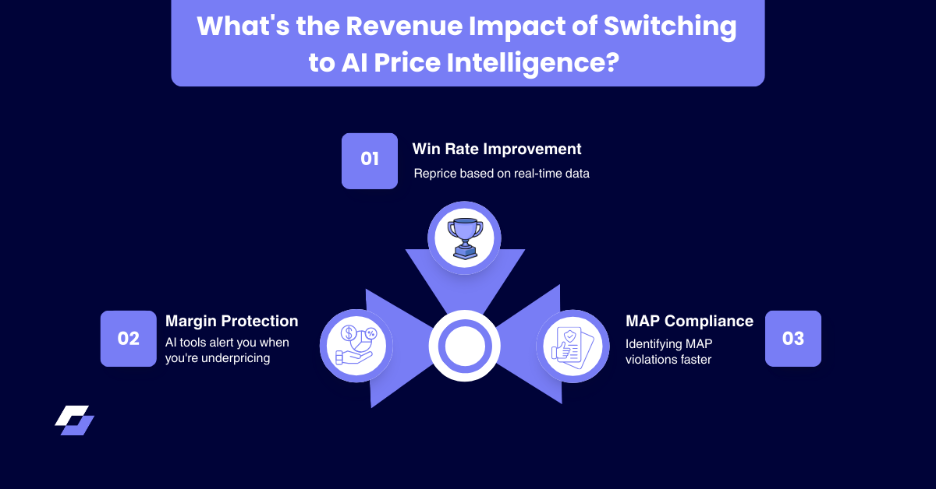
The revenue impact of upgrading from manual to AI-powered competitive price monitoring is measurable and often immediate.
Revenue gains typically come from three areas:
Win Rate Improvement: Businesses that reprice based on real-time data win more price-sensitive customers. Even a 2-5% increase in conversion rate on competitive SKUs drives significant monthly revenue.
Margin Protection: AI tools alert you when you're underpricing relative to the market - stopping unnecessary margin of erosion. Many businesses recover 3-8% gross margin within the first 90 days (about 3 months).
MAP Compliance Enforcement: Identifying MAP violations faster means fewer unauthorized discounts damaging your brand's equity and retailer relationships.
According to industry benchmarks, businesses using AI-powered retail price optimization report 10-25% improvement in pricing decision speed and 5-15% improvement in gross margin within six months of implementation.
Who Should Make the Switch to AI Price Intelligence?
AI-based price intelligence isn't only for retailers. Today's platforms are accessible for mid-market eCommerce brands, specialty retailers, distributors, and manufacturers managing MAP policies.
You may be ready to switch to an AI pricing intelligence solution if your business tracks more than 100 SKUs across three or more competitors, and your pricing team spends more than five hours each week on manual research. Many companies also consider upgrading when they lose sales due to outdated or inaccurate competitor data or operate in high-velocity markets where prices change daily.
The need to enforce MAP policies across a distribution network or implement dynamic and smart repricing strategies is another strong indicator that a more automated pricing approach is needed.
PriceIntelGuru is built for exactly these use cases. Our platform covers eCommerce, automotive parts, retail, and manufacturing verticals with industry-specific features and dedicated support to ensure a fast time to value.
Stop Tracking Prices Manually. Start Winning with AI Price Intelligence
The debate between manual price tracking vs AI-based price intelligence was settled long ago by the numbers. Manual processes are expensive, error-prone, and scale-limited. AI price intelligence is faster, more accurate, more affordable per insight, and directly tied to revenue growth.
If you're still relying on spreadsheets and manual research, every day you wait is a day your competitors are using real-time pricing data to win customers you could have had.
PriceIntelGuru gives you the edge through automated competitive price monitoring, smart product matching, dynamic pricing tools, and insights built for your industry. It's time to upgrade your pricing strategy.
Ready to make the switch? Explore our product matching solution and pricing intelligence platform or request a demo today.
Upgrade your pricing strategy today.
See how AI-based price intelligence helps businesses automate competitor monitoring and respond to market changes in real time.
Request a Demo