


.png)


© 2025 PriceIntelGuru. All Rights Reserved
If you have searched for price intelligence software cost, you already know the answer is rarely simple. Vendors rarely publish pricing on their websites, and the range between a basic starter plan and a full deployment can span tens of thousands of dollars per year. For eCommerce managers, retail buyers, and pricing teams evaluating solutions, understanding what drives those costs is the first step toward making a confident, ROI-positive investment.
This guide breaks down every major pricing model, the factors that push price intelligence software costs up or down, and what should expect to budget so you can evaluate vendors on equal footing.
What Is Price Intelligence Software and Why Does Cost Vary So Much?
Pricing intelligence software collects, cleans, and analyzes competitor prices, market trends, and product data across retailers, marketplaces, and distribution channels. It powers competitor price monitoring, dynamic repricing, MAP (Minimum Advertised Price) compliance tracking, and competitive product pricing decisions at scale.
The cost varies dramatically because the scope of these tools ranges from lightweight browser extensions tracking a few dozen SKUs, ingesting millions of data points daily across dozens of markets.
The 4 Most Common Pricing Models for Price Intelligence Software
1. Tiered Subscription Plans
This is the most prevalent model. Vendors offer three to five tiers typically labeled Starter, Growth, Professional, and each tier unlocking more SKUs, more frequent data refreshes, and more advanced features. Entry-level plans for small retailers often start at $99-$299/month. Mid-market plans covering 5,000-25,000 SKUs typically land in the $500-$2,000/month range. Plans with unlimited SKUs, API access, and custom integrations frequently exceed $3,000-$8,000/month before volume discounts.
2. Usage-Based (Pay-Per-SKU or Pay-Per-Request) Pricing
Some pricing optimization software vendors charge per SKU monitored or per API call made. This model suits businesses with seasonal or highly variable product catalogs. The unit cost typically falls between $0.001 and $0.05 per data point depending on update frequency and source complexity. At scale, usage-based pricing can be cost-efficient - but it can also produce unpredictable invoices if monitoring expands rapidly.
3. Custom Contracts
Large retailers, manufacturers, and brands with complex multi-market requirements typically negotiate annual contracts directly with vendors. These deals bundle data ingestion, dedicated infrastructure, custom product matching algorithms, professional services, and SLAs into a single negotiated price. Annual contract values for deployments range from $30,000 to well over $150,000 depending on scope, with multi-year commitments often yielding 15-25% discounts.
4. Modular / Add-On Pricing
An emerging model in space involves a core platform fee supplemented by paid add-ons. A business might pay a base subscription for standard competitor price monitoring and then purchase add-ons for dynamic repricing, MAP compliance alerts, product matching, or SKU-level price analysis. This model offers budget flexibility but requires careful scoping to avoid feature gaps.
Key Cost Drivers: What Makes Pricing Intelligence Software More Expensive?
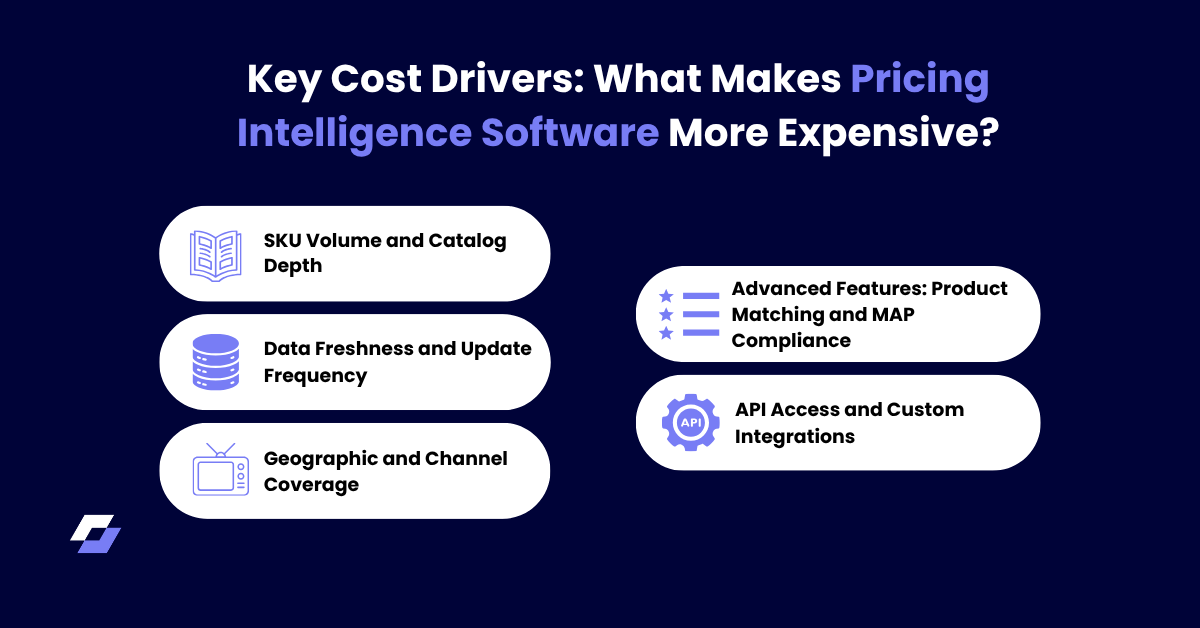
When comparing quotes from multiple vendors, these are the variables that most commonly explain price differences:
1. SKU Volume and Catalog Depth
The number of products you need to monitor is the single biggest pricing lever. Ecommerce price tracking for 500 SKUs is a fundamentally different infrastructure problem than tracking 500,000 SKUs across 50 competitor sites. Always ask vendors exactly what SKU tier you fall into and what the overage cost is if you exceed it.
2. Data Freshness and Update Frequency
Real-time or near-real-time pricing data costs significantly more to deliver than end-of-day snapshots. For businesses that rely on dynamic repricing tools to automatically adjust prices on Amazon, Shopify, or their own D2C store, hourly or sub-hourly data is non-negotiable. Expect to pay a meaningful premium sometimes 40-60% more for intraday data over daily refresh plans.
3. Geographic and Channel Coverage
Monitoring prices across a single country cost less than tracking competitive prices across the US, UK, EU, and Asia Pacific simultaneously. Multi-channel coverage adding Amazon, Walmart, eBay, Google Shopping, and direct competitor websites also increases infrastructure costs and, in turn, subscription pricing.
4. Advanced Features: Product Matching and MAP Compliance
Commodity price scraping is relatively cheap. But intelligent features like competitive product pricing analysis, AI-powered product matching across different SKU naming conventions, and automated MAP compliance software alerts require substantially more sophisticated engineering. These capabilities typically appear at Professional and they are worth every dollar for brands selling through multi-channel or authorized dealer networks.
5. API Access and Custom Integrations
Raw API access to price data for feeding repricing engines, BI tools, or ERP systems is almost always gated behind higher-tier plans. If your team needs programmatic access rather than a dashboard-only workflow, factor in the cost of an API-enabled plan from day one.
Typical Cost Range
Here is a general cost framework based on common team sizes and catalog scales:
- Small retailers (up to 1,000 SKUs): $99-$499/month. Basic competitor tracking, daily data refreshes, limited competitor sources.
- Mid-market eCommerce (1,000-25,000 SKUs): $500-$2,500/month. Broader competitor coverage, weekly or daily data, dashboard analytics, some alerting.
- Large retailers and brands (25,000-250,000 SKUs): $2,500-$8,000/month. Frequent data, API access, MAP tracking, product matching, and priority support.
- Multi-market (250,000+ SKUs or global): $8,000-$20,000+/month or custom annual contract. Real-time data, dedicated infrastructure, full API, custom integrations, SLA guarantees.
Note: These ranges reflect public market rates across multiple vendors. Actual pricing will vary based on contract length, feature selection, and negotiated terms.
Why PriceIntelGuru Delivers the Best ROI on Pricing Intelligence
PriceIntelGuru is purpose-built to address the pricing challenges, including high SKU volumes, multi-channel complexity, large-scale product matching, and the need for actionable insights rather than raw data exports. Unlike many legacy solutions, PriceIntelGuru combines comprehensive competitor price monitoring across eCommerce, automotive aftermarket, and retail verticals with AI-powered product matching that accurately aligns competitor SKUs even when naming conventions differ.
The platform also includes MAP compliance monitoring with automated alert workflows to help protect brand integrity and channel relationships, along with smart repricing rules that connect market intelligence to real-time price adjustments. With transparent and scalable pricing designed to grow alongside your catalog across eCommerce, automotive parts, retail, and manufacturing rely on PriceIntelGuru to significantly reduce time-to-reprice and protect margins in highly competitive markets.
Conclusion
Understanding price intelligence software cost is ultimately about finding the right investment, not the cheapest one. Pricing models vary; cost drivers are nuanced, and the gap between a tool that demos well and one that performs at scale is significant. When the right platform is in place, the return far outpaces the subscription cost. PriceIntelGuru gives your team the competitor price monitoring, product matching, and repricing intelligence it needs to make faster, more profitable decisions at any catalog size.