
.png)




© 2025 PriceIntelGuru. All Rights Reserved
Pricing in the fast-moving consumer goods world has never been more complicated or more consequential. Margins are thin, competition moves fast, and shoppers switch brands with almost no friction. One retailer drops a price on a Tuesday morning and, if you're not watching, your carefully crafted pricing strategy is already irrelevant by Wednesday.
That's exactly what makes FMCG pricing intelligence one of the most high-leverage investments a brand or retailer can make right now. This guide breaks down what it is, why it matters, and how to act on it.
What Is FMCG Pricing Intelligence?
FMCG pricing intelligence is the continuous process of collecting, analyzing, and acting on competitor price data across the fast-moving consumer goods market. It goes beyond simply checking what a rival charges for a similar product. Done properly; it maps pricing across retailers, channels, geographies, and time giving brands and retailers a live view of where they stand in the market at any given moment.
The term is often used interchangeably with consumer-packaged goods for price monitoring, or CPG pricing intelligence, since the two categories overlap heavily. The same pricing challenge exists for all product categories which include personal care products beverages household cleaning items and packaged snacks because prices change throughout the day at multiple retail locations.
A proper price intelligence platform for CPG brands pulls this data automatically, normalizes it, and surfaces the insights that actually matter not just raw numbers, but context.
Why Pricing Is So Difficult in the FMCG Industry
Grocery and CPG are one of the most price-sensitive retail categories in existence. Shoppers in this space are trained to compare. Private label alternatives are always a click or a shelf away. Promotions run constantly. And the same product might sell at five different prices across five different online retailers on the same day.
The manufacturers face additional difficulties because of their multiple distribution channels. Your product might be listed on a national grocery chain website on a regional eCommerce platform for a third-party marketplace and a direct-to-consumer storefront all simultaneously. The entire pricing system needs automated solutions to create an accurate understanding of how your pricing operates across different platforms. There is no effective manual solution to this problem.
Retailers encounter a duplicate version of their existing challenge. They need to know not just what a competing retailer charges yet also need to know when that price changes and how long the promotion lasts and whether it constitutes a featured deal or a quiet markdown and what the price movement pattern demonstrates during different time periods. The collection of detailed competitive data, which includes time-stamped information, enables businesses to implement reactive pricing methods or establish strategic pricing systems.
What Does a Price Intelligence Platform for CPG Actually Track?
The short answer: more than most teams realize. A modern FMCG price tracking software doesn't just snapshot current prices. It builds a longitudinal record of pricing across competitors, channels, and SKUs. Here's what that typically includes:
Competitor price movements: Real-time and historical price changes across retailers, both online and click-and-collect.
Promotional activity: Identifying when competitors run deals, bundle offers, or temporary discounts, and how frequently.
Product matching: Mapping your SKUs equivalent or competing products across retailers, even when product names and pack sizes differ.
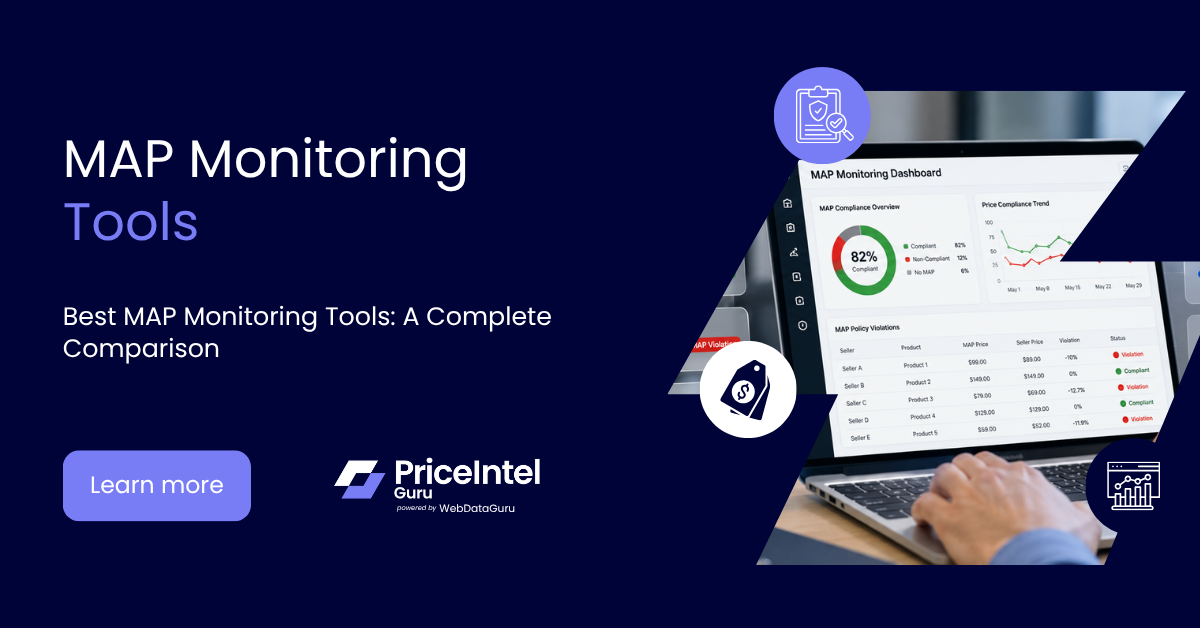
MAP compliance monitoring for brands, tracking whether authorized resellers are honoring minimum advertised price agreements and flagging violations in real time.
Marketplace pricing: Monitoring third-party seller behavior on platforms like Amazon and Walmart Marketplace, where pricing can be fragmented quickly.
Geo-specific pricing: Capturing regional price differences, which matter considerably in large markets like the US, UK, and Germany.
This combination of data points is what transforms raw price information into genuine FMCG competitive pricing intelligence.
How CPG Brands Use Pricing Intelligence Differently Than Retailers
Brands and retailers are both consumers of price intelligence data, but they use it for different ends, and the distinction matters when choosing the right tool.
For CPG brands, the primary concerns are brand equity and channel control. A brand manager wants to know whether a retailer is pricing their product in a way that undercuts the brand's premium positioning, whether MAP violations are eroding reseller trust, and whether promotional discounts in one channel are creating price expectation problems in another. Product intelligence understanding how your product is described, positioned, and reviewed relative to competitors is also a growing priority.
For retailers, the goal is more transactional but equally complex. Retail pricing intelligence for FMCG is about staying competitive on the products that drive footfall and basket size, without sacrificing margin across the rest of the assortment. Smart Repricing The automated adjustment of prices based on live competitive data and pre-set business rules is typically the end goal for retailers operating at any meaningful scale. Getting there requires accurate, high-frequency data and a system that can act on it without requiring manual intervention for every SKU.
The Role of Product Matching in FMCG Price Monitoring
One of the most underappreciated challenges in consumer-packaged goods price monitoring is product matching the process of correctly identifying that a competitor's "6-pack, 330ml" SKU is the same product as your "six-count, 11.2 fl oz" listing, despite the naming difference.
In FMCG and CPG, this problem is pervasive. Pack sizes vary by channel. Bundled formats exist alongside single-unit listings. Private label alternatives need to be identified as relevant comparisons even when no brand name overlap exists. Flavors, variants, and regional formulations add another layer.
Without accurate product matching, your competitive pricing data is contaminated. You might be pricing against the wrong benchmark entirely. PriceIntelGuru's product matching software operates at 99.2% accuracy, which is meaningful at scale, where a single percentage point of error across thousands of SKUs translates into a substantial number of bad decisions downstream.
Building a CPG Pricing Strategy Around Intelligence Data
Data alone doesn't win margins. What matters is how you translate market signals into pricing decisions. Here's how leading FMCG brands and retailers structure their approach:
1. Start with a competitive baseline
Before making any pricing changes, you need to know where you actually stand relative to your key competitors. This means mapping your full assortment against equivalent products and establishing a current price index.
2. Identify your pricing tier
Are you consistently priced at a premium, at parity, or at a discount relative to your category? Is that intentional? Market data often reveals that a brand thinks it's premium-positioned but is actually pricing at parity due to promotional activity.
3. Define repricing rules by product tier
Not every SKU should be repriced the same way. High-velocity, price-sensitive SKUs might warrant near-real-time adjustments. Low-volume specialty products might need manual review. A good CPG pricing strategy guide will segment the assortment before applying any automation.
4. Monitor for market events, not just price points
A competitor's sudden price drop might mean a clearance event, a promotional campaign, or a permanent reposition. The pattern over time tells you which, and that distinction should drive your response.
5. Feed intelligence back into trade and promotional planning
Some of the highest-value uses of pricing data aren't reactive at all. Knowing how competitors structure their promotional calendar months in advance allows you to plan counter programming rather than scrambling to respond.
FMCG Pricing Intelligence: Key Market Statistics
Before diving deeper into execution, it helps to understand just how significant pricing intelligence has become in the FMCG and CPG landscape. The numbers below highlight why pricing is now one of the most critical growth levers for brands and retailers:
- Nearly 70-80% of FMCG purchase decisions are influenced by price, especially in categories like groceries, personal care, and household essentials.
- Studies show that even a 1% price optimization improvement can increase operating profit by 5-10%, making pricing one of the highest-impact levers in retail.
- Around 60% of consumers regularly switch brands based on price changes, particularly in highly commoditized categories like packaged foods and beverages.
- Online and omnichannel retailers update prices multiple times per day, with some high-competition SKUs seeing changes every few hours.
- More than 50% of retailers now use some form of automated pricing or repricing technology, and that number continues to grow as competition intensifies.
- Promotions account for 30-40% of total FMCG sales volume in many markets, showing how heavily pricing tactics influence demand.
These figures reinforce a simple reality: pricing is no longer just a tactical decision in FMCG. It is a strategic function that directly impacts revenue, margin, and market share.
What to Look for in FMCG Price Tracking Software
If you're evaluating platforms, the gap between tools in this space is wider than most buyers expect. Here are the factors that genuinely differentiate solutions at scale:
1. Data freshness
Daily data might be sufficient for slow-moving categories. In FMCG, promotional prices require intraday or near-real-time tracking because they remain active for 24 hours. You should inquire about the specific crawl frequency and its associated data latency.
2. Geographic coverage
You require platform verification for your markets because your business operates in multiple countries. The United States, United Kingdom, Germany, and Australia require specific retailer information because they do not accept general country-based data as valid evidence.
3. Product matching accuracy
This is non-negotiable for FMCG, as covered above. Request specifics on methodology and ask for benchmark data, not just marketing claims.
4. MAP monitoring capabilities
For brands, this is often as important as competitive pricing. The platform needs to monitor MAP violations which occur through direct retailers and through marketplace third-party sellers.
5. Integration and delivery options
No matter whether you require a SaaS dashboard, API data feed, or maybe a fully managed DaaS, the perfect data provider would likely provide you with data where you already have your infrastructure.
Common Pitfalls in FMCG Competitive Pricing
Even teams with good data make avoidable mistakes. A few worth calling out:
Racing to the bottom. Repricing solely to match the lowest market price is a strategy that destroys margin fast. Competitive pricing intelligence should inform decisions, not automate a price war. Repricing rules should include margin of floors, not just competitor benchmarks.
Ignoring a private label. Private label alternatives are frequently the most relevant competitive threat in FMCG, not a named brand competitor. Any serious price monitoring setup needs to include own-brand and store-brand products as benchmarks.
Treating all channels as equivalent. A price on a major grocery retailer's website carries a different weight than the same price on a regional marketplace. Channel weighting matters when you're aggregating competitive signals.
Reacting without pattern recognition. A single data point is just noise. A pricing trend over time is a signal. Teams that act on single observations rather than patterns end up chasing their own tail.
The Bottom Line
Pricing in FMCG isn't a set-and-forget exercise. It's a continuous, competitive, data-intensive discipline that rewards brands and retailers who treat it seriously and punishes those who don't. The combination of automated consumer packaged goods, price monitoring, accurate product matching, and smart repricing capabilities is no longer a competitive advantage reserved for the largest players. It's table stakes for anyone competing seriously in this category. The question isn't whether to invest in pricing intelligence. It's whether to do so before or after your competitors do.