






© 2025 PriceIntelGuru. All Rights Reserved
Auto parts price monitoring across Amazon, eBay, and Walmart means tracking your competitors' pricing, stock levels, and promotions on all three marketplaces in real time, then using that data to reprice your own listings before you lose the sale or the margin. For auto parts retailers and distributors, these three channels represent an enormous share of online demand, and prices on them shift constantly. Without automated monitoring, sellers are pricing blind.
In this guide, you'll learn why auto parts prices change so frequently, how auto parts price monitoring differs across Amazon, eBay, and Walmart, and what to look for in auto parts pricing software. You'll also see how accurate product matching and MAP compliance monitoring fit into a complete pricing strategy for OEM and aftermarket parts.
This matters because pricing mistakes in auto parts compound quickly. A part priced too high loses the Buy Box within hours, while a part priced too low erodes margin across every unit sold until someone catches it.
Why Does Auto Parts Pricing Change So Often on Marketplaces?
Auto parts prices shift constantly because sellers compete on thin margins across identical or near-identical SKUs. A single part number, like a brake rotor or an alternator, can be listed by dozens of sellers on Amazon, eBay, and Walmart at the same time, and each of those sellers is watching the others closely.
Repricing bots are one of the biggest drivers of this volatility. Large sellers and distributors run automated repricing tools that adjust prices multiple times a day, sometimes every few minutes, based on what competitors are charging at that exact moment. If your prices are only reviewed weekly or monthly, you're competing against systems that never stop moving.
Seasonal demand adds another layer of unpredictability. Winter tires, batteries, and antifreeze see sharp price swings heading into cold months, while AC components, coolant systems, and cabin filters spike in demand through summer. Sellers who anticipate these cycles and reprice ahead of the curve capture more sales at better margins than those who wait for demand to show up in their own sales data first.
Inventory shortages compound the problem further. When OEM parts run low, whether due to manufacturer backorders or supply chain disruptions, the price gap between OEM and aftermarket alternatives can widen or narrow within days. A part that was priced competitively last week might suddenly be significantly overpriced or underpriced once a competitor's stock situation changes.
Marketplace mechanics push prices lower too. Amazon's Buy Box algorithm and Walmart's marketplace-low pricing checks both reward the lowest qualifying price, which creates constant pressure for sellers to undercut each other just to stay visible. Even a small, temporary price drop from one seller can trigger a chain reaction across every other listing for that same part.
All of this adds to a pricing environment that never holds still. If you're not watching these shifts as they happen, whether through manual checks or automated monitoring, you're reacting days too late, and in auto parts, a few days can mean the difference between winning the sale and losing it entirely.
What Makes Price Monitoring Different on Amazon vs. eBay vs. Walmart?
Each marketplace rewards a different pricing behavior, so a one-size-fits-all strategy rarely works for auto parts sellers.
Amazon ties pricing directly to Buy Box eligibility. Even a few cents above the lowest price can knock you out of the Buy Box entirely, which is why real-time Amazon auto parts price monitoring is critical for sellers who depend on that visibility.
eBay rewards a mix of price and seller reputation, and auction-style listings can create pricing patterns that don't exist on fixed-price channels. eBay auto parts price tracking needs to account for both current listings and recently sold comparables.
Walmart enforces stricter marketplace pricing policies and can suppress listings that are priced above the "market low" it detects elsewhere. Walmart auto parts price monitoring must catch these violations before they hurt your listing visibility.
Because the rules differ by channel, auto parts sellers need a platform built to normalize and compare pricing data across all three, not just pull raw numbers.
How Does Auto Parts Price Monitoring Software Work?
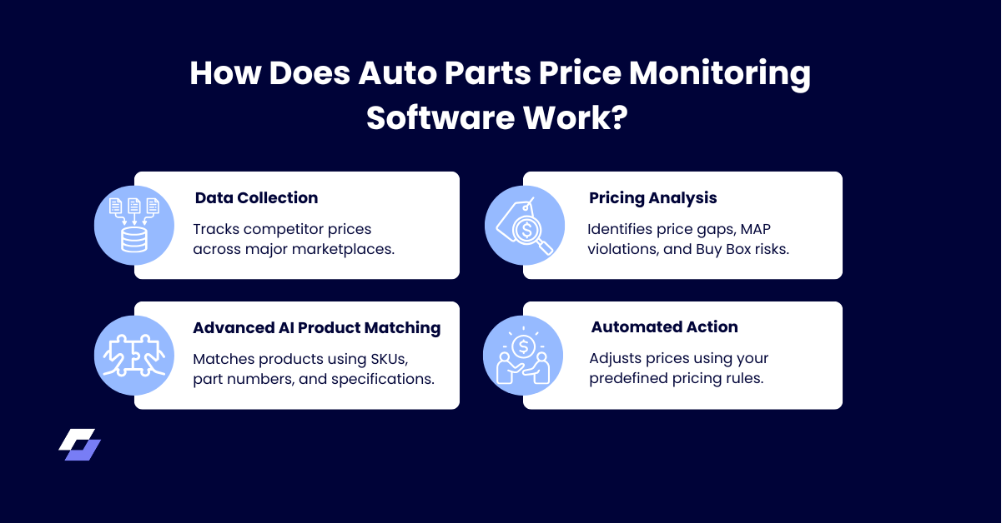
Auto parts price monitoring software works by continuously scanning competitor listings across your chosen marketplaces, matching those listings to your own catalog by part number and fitment, and alerting you the moment a price, stock level, or promotion changes.
The core process breaks down into four steps:
- Data collection – the software crawls Amazon, eBay, Walmart, and other channels around the clock
- Advanced AI Product matching – AI matches competitor listings to your SKUs using part numbers, fitment data, and specifications, not just product titles
- Analysis – the platform benchmarks your price against competitors and flags gaps, MAP violations, or Buy Box losses
- Action – you either review the data manually or let automated repricing rules adjust your prices within limits you set
Why Does Product Matching Matter in Automotive Parts?
Product matching matters more in auto parts because a single part often has multiple valid identifiers, OEM numbers, aftermarket part numbers, and fitment codes; that all need to be reconciled before a price comparison means anything.
A brake pad set from an OEM supplier and its aftermarket equivalent might look completely different in a listing title but function identically in a vehicle. If your monitoring tool matches only keywords, it will miss these equivalents or, worse, compare your part to something that doesn't fit the same vehicle.
This is why AI-driven, fitment-aware advanced AI product matching, rather than basic title scraping, is the foundation of reliable auto parts price intelligence.
How Can Auto Parts Retailers Protect Margins While Staying Competitive?
Auto parts retailers protect margins by combining competitor price tracking with rules-based repricing that has margin floors built in, so prices adjust to stay competitive without dropping below profitability.
Practical margin-protection tactics include:
- Setting minimum price thresholds tied to landed cost, not just list price
- Prioritizing repricing on high-velocity SKUs where Buy Box position matters most
- Using stock-level data to hold prices firm when competitors are low on inventory
- Applying seasonal pricing rules ahead of predictable demand shifts
Retailers using automated, data-driven repricing typically see 15 to 30 percent margin improvement and 28 percent faster revenue growth compared to manual pricing methods.
What Role Does MAP Compliance Play in Auto Parts Monitoring?
MAP compliance plays a critical role because auto parts brands and distributors often set minimum advertised prices to protect brand value, and violations on marketplaces can damage relationships across the entire distribution network. Under U.S. antitrust guidance, the Federal Trade Commission notes that a manufacturer is generally free to set its own resale price policy and decide not to work with retailers who ignore it, which is why enforcing MAP consistently matters both legally and commercially.
Monitoring MAP violations across Amazon, eBay, and Walmart requires the same real-time visibility as competitor price tracking, since unauthorized sellers frequently undercut MAP pricing to win the Buy Box or attract clicks. Automated compliance monitoring flags these violations as they happen, so brands can act before the damage spreads across other retail partners.
How Do You Choose the Right Auto Parts Pricing Software?
Choosing the right auto parts pricing software comes down to matching accuracy, marketplace coverage, and how well the platform fits into your existing pricing workflow.
Key criteria to evaluate:
- Marketplace coverage – the software should track Amazon, eBay, Walmart, and every other channel where you sell
- Matching accuracy – it should match parts by part number and fitment data, not just keyword similarity
- Repricing flexibility – you should be able to set margin floors and custom rules rather than relying on fully automated pricing with no guardrails
- Data delivery – it should offer the format you need, whether that's a SaaS dashboard, API access, or raw data feeds
- Scalability – it should handle your full SKU catalog as your business grows
Conclusion
Auto parts price monitoring across Amazon, eBay, and Walmart isn't a one-time setup. It's an ongoing discipline that separates sellers who protect their margins from sellers who react too late. The marketplaces move fast; competitors reprice constantly, and OEM versus aftermarket comparisons only work when your matching is accurate down to the part number and fitment.
Getting this right comes down to three things: real-time visibility across every channel you sell on, product matching that understands automotive parts specifically, and a repricing strategy with margin floors built in so competitiveness never comes at the cost of profitability. Retailers who combine all three consistently outperform those still pricing by spot-checking competitor listings manually.
PriceIntelGuru's automotive parts pricing software brings that visibility into one platform, with advanced AI product matching and advanced AI dynamic pricing built specifically for the complexity of OEM and aftermarket catalogs, across 10M+ products in 50+ countries.