



.png)




© 2025 PriceIntelGuru. All Rights Reserved
If you distribute lumber, roofing, insulation, concrete products, or any other building materials in the US, you already know that pricing is no longer a back-office spreadsheet exercise. It is a daily competitive battlefield. Suppliers are changing their costs with little notice. Online platforms are undercutting regional distributors on SKUs that used to carry reliable margins. Contractors are doing their own research before they call you. And yet, most distributors are still making pricing decisions based on gut feel, quarterly cost reviews, and whatever the sales rep overheard at a trade show.
That is exactly the problem that building materials price intelligence is designed to solve. This guide walks through what it means, why it matters more in 2026 than it ever has, what to look for in the right tools, and how to build a pricing approach that holds up when the market moves against you.
Why the Building Materials Market Makes Pricing So Difficult Right Now
The building materials sector is uniquely volatile. Unlike consumer electronics or apparel, where the whole price shift thing gets driven mostly by demand, construction material costs are more “pushed and pulled” by this mix of raw material expenses, energy prices, shipping rates, tariff policy, and regional labor dynamics. Lumber futures have swung dramatically. Gypsum and insulation costs have been affected by both domestic capacity constraints and import duties. Copper and steel continue to respond to geopolitical shifts faster than most distributor pricing systems can track.
What makes this particularly painful for distributors is margin compression from two directions simultaneously. Suppliers are passing cost increases upstream, while digital competitors, including national ecommerce players and large-format home improvement retailers with real-time pricing tool, are pushing prices down on the same SKUs. Distributors caught in the middle, without live market visibility, are either leaving money on the table or losing jobs entirely because their quoted price looked too high to a contractor who just checked online.
What Building Materials Price Intelligence Actually Means
Before diving into tools and tactics, it helps to be precise about terminology. Price intelligence for building materials refers to the systematic, automated collection and analysis of competitor pricing data across the market, applied specifically to the products a distributor carries or competes on. It is not the same as cost accounting. It is not about knowing what your supplier charges you. It is about knowing, in real-time, what your competitors are charging in your market for comparable products.
The Real Cost of Flying Blind on Competitor Pricing
Most distributors underestimate how much unmanaged pricing costs them. The obvious loss is in deals where a competitor wins because their price was sharper on a line item the contractor was shopping for. That is visible and painful. The less obvious loss is margin given away on jobs where the distributor had no reason to be cheap. When your team cannot see what competitors are actually charging, the instinct under pressure is to discount. That habit, repeated across hundreds of transactions a month, erodes profitability in ways that rarely show up in a single lost bid but absolutely show up in annual margin reviews.
Competitive pricing in the building industry also has a longer-cycle dimension that makes this worse. A general contractor who gets a better price from a competitor on one project may switch their preferred supplier entirely, taking years of repeat business with them. The cost of losing that relationship is not one margin point on one job.
What to Look for in Price Intelligence Software for Distributors
Not all pricing tools are built for the realities of building materials distribution. Most price intelligence software was designed for retail ecommerce, where products have clean UPCs, consistent descriptions, and national pricing. Building materials distribution is different. Products are sold in varying units (per board foot, per sheet, per pallet, per linear foot), described inconsistently across competitors, and priced differently by geography and account type.
Price intelligence software for distributors needs to handle that complexity. The capabilities that actually matter in this vertical include: product matching that can identify the same SKU described differently across multiple competitors, geographic pricing filters so you are comparing your local market rather than a national average, coverage across both online and offline competitors (including regional yards and national chains), and alerting logic that flags significant price movements without burying your team in noise.
PriceIntelGuru tracks over 10 million competitor prices through its AI-powered platform and is built to handle the kind of catalog complexity that building materials distributors actually operate with. Its product matching engine delivers 99.2% accuracy, which matters enormously when you are trying to compare a competitor's "4x8 5/8 Fire-Rated Drywall" against your own SKU described in slightly different terms.
How to Build a Smarter Building Materials Pricing Strategy
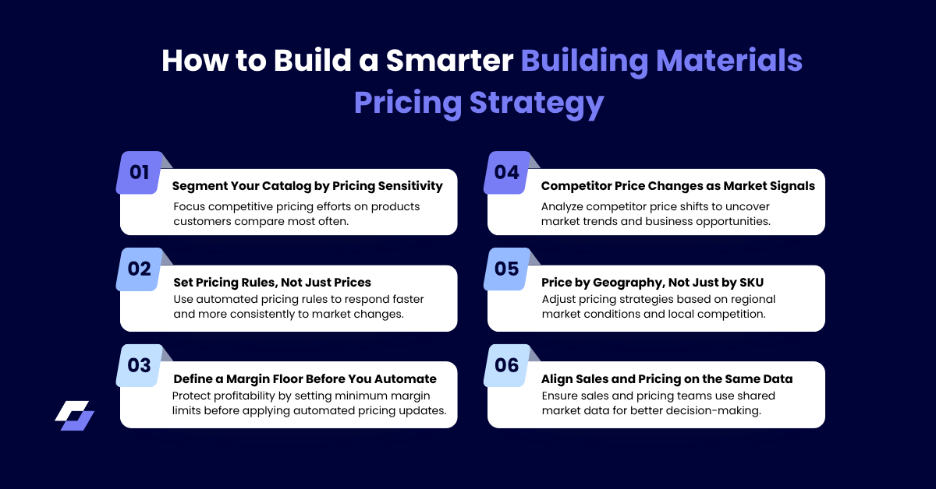
Having price data is only half the equation. The distributors who get the most out of price intelligence are the ones who build a systematic building materials pricing strategy around what the data tells them, rather than reacting to one quote at a time.
1. Segment Your Catalog by Pricing Sensitivity
A practical approach starts with segmenting your catalog by pricing sensitivity. Not every SKU is equally shopped. Commodity products like dimensional lumber, drywall, and PVC pipe are frequently price-checked by contractors. Specialty or value-added items, custom orders, and products where your lead time or service level differentiates you are less sensitive. Price intelligence investment should be weighted toward the commodity segment, where being wrong by a few percentage points has an immediate impact on win rates.
2. Set Pricing Rules, Not Just Prices
From there, the strategy kind of involves setting pricing rules rather than actual prices. Instead of changing every SKU by hand when a competitor moves, you establish bands and a bit of logic: match the lowest competitor that sits inside a defined margin floor on the high-volume, commodity SKUs, hold price steady on the more differentiated items, and flag anything where you are more than 5% above the market for manual review. This rule-based approach is what really separates distributors that operate at scale from the ones still doing it by feeling.
3. Define a Margin Floor Before You Automate
One mistake distributor makes when first deploying pricing rules is automated without protecting the bottom line. Before any rule goes live, define a hard margin of floor for each product category, below which no automated adjustment should fire. This ensures that competitive matching never accidentally becomes a race to zero. Your pricing engine should be chasing market position within a profitable range, not simply following the lowest price in the market regardless of what it costs you.
4. Competitor Price Changes as Strategic Market Signals
Price shifts from competitors carry more information than just the number. Like when a regional competitor drops their price sharply, on one product category, it can often point to excess inventory, a slower demand cycle, or even a deliberate attempt to guard against a key account relationship. Training your team to actually read those signals instead of just reacting to the number, gives you a real strategic advantage. Over time, the patterns in competitor pricing behavior start to feel almost as valuable as the price data itself.
5. Price by Geography, Not Just by SKU
Building materials pricing is deeply regional. The competitive set in the Southeast for roofing products looks nothing like the Pacific Northwest. Freight costs, local supplier relationships, and regional construction activity all create pricing dynamics that a single national strategy cannot capture. A distributor with multiple branches should maintain pricing logic that reflects local market conditions rather than applying a uniform approach across the entire catalog. That is where serious margin recovery tends to happen.
6. Align Sales and Pricing on the Same Data
Even the best pricing strategy breaks down if the sales team is working from a different set of assumptions than the pricing team. One of the underappreciated benefits of a structured price intelligence process is that it gives both teams a shared factual baseline. When a sales rep wants to discount a product to win a job, the conversation changes entirely when both parties can see exactly where that product sits relative to the market. It becomes a business decision grounded in data rather than a negotiation based on anecdote.
What the Best Construction Material Pricing Tools Actually Do
The category of construction material pricing tool has expanded significantly in the past two years. At the basic end, you have web scrapers that pull public pricing from competitor's websites and deliver it in a spreadsheet. Those tools are useful for occasional benchmarking but too slow and too manual for day-to-day pricing decisions. At the more sophisticated end, you have platforms that combine automated data collection with AI-powered analysis, integration with your ERP or pricing engine, and dashboards built for pricing managers rather than data analysts.
What separates genuinely useful tools from expensive noise is the quality of the underlying data and how actionable the interface makes it. A pricing manager at a mid-size distributor does not have time to cross-reference three spreadsheets before approving a quote. They need to see, briefly, where they stand on the SKUs that are actively being bid and what the recommended action is. The best platforms are built around that workflow, not around demonstrating how much data they can collect.
AI Pricing for Distributors in 2026: Where the Technology Is Headed
The application of artificial intelligence to distributor pricing has matured considerably. A few years ago, AI pricing for distributors in 2026 conversations was largely theoretical. Today, the technology is practical and already deployed by forward-thinking distributors. The shift worth understanding is from descriptive intelligence, telling you what competitors charge today, to predictive and prescriptive intelligence, anticipating where prices are heading and recommending specific actions.
AI models trained on past pricing data, recurring seasonal demand rhythms, raw material cost indexes, and what competitors are doing can now spot likely price movements before they happen. This gives pricing teams inside a distributor a real planning edge. Instead of scrambling to react after, say, a competitor cuts price by 8% on dimensional lumber right before a hectic construction quarter , a distributor using AI-driven insights can get ahead of it, meaning they can shift their own market positioning , secure supplier costs, or even speed up inventory buys while the margins still make sense and don’t fall apart.
PriceIntelGuru's Smart Repricing feature brings that kind of intelligence to distributors, enabling automated pricing responses based on pre-set business rules and AI-derived market signals. For distributors managing thousands of SKUs across multiple locations, that level of automation is not a luxury. It is how you stay competitive without adding headcounts to your pricing team.
How PriceIntelGuru Transforms Pricing for Building Materials Distributors
PriceIntelGuru is built specifically for companies that operate in complex, multi-SKU, multi-channel environments where accurate product matching and fast data refresh rates are non-negotiable. For building materials distributors, the platform provides live competitor price monitoring, MAP compliance tracking for manufacturer relationships, and Smart Repricing automation that can be configured around your own margin rules.
The platform covers 50+ countries, which matters for distributors who source internationally or operate across borders. And with delivery models that include SaaS, DaaS, and API options, it fits into existing distributor tech stacks rather than requiring a complete systems overhaul. Clients using the platform have reported margin improvements of 15 to 30%, along with significantly faster response times when competitor pricing shifts.