







© 2025 PriceIntelGuru. All Rights Reserved
Pricing teams usually find out their competitor price checks are off in one of two ways. They either get notified about a competitor’s sale several days later or they get bombarded by emails so much that nobody reads them anymore. In both instances, the monitoring schedule has never been adjusted around the catalog. Real-time competitor price monitoring should be scheduled for products being compared by customers before making purchases, and the rest should be checked much less frequently. Here’s how to set the right check frequency for each part of your catalog.
Why a Single Monitoring Schedule Fails Large Catalogs
Let’s consider an example from a consumer electronics brand with 50,000 SKUs to show how this plays out. Several dozen resellers sell the wireless earbuds of a particular brand through the channels of Amazon, Walmart and Best Buy, and the price of one listing can change 4 or 5 times per day. The price of the replacement ear tips doesn’t vary for months.
If both products are checked once a day, the data collected about earbuds will become a static picture of a dynamic process. The promotions which start and finish during the interval between checks won’t be included in the final result and therefore it’ll be impossible to understand whether the competitor tested a lower price or accepted it permanently. The ear tips are monitored in the same way every day and most of the time they don’t change. Across thousands of similar accessories such expenses are very high.

What Decides How Often You Should Check Competitor Prices
There are four factors that can be analyzed in order to understand how frequently a product category needs checking, and you can pull all of them from the pricing data you already have.
The sales channel requires scrutiny since it can split one product into two. For instance, there are many changes in prices each week for the straight-leg jeans of a national denim brand on Amazon and Macy’s.com due to flash and seasonal sales. On the wholesale portal that supplies boutique retailers, the same jeans keep one price all season. So one SKU needs two schedules: frequent checks on marketplaces and a seasonal review on the wholesale channel.
Matching Check Frequency to Your Product Tiers
Once you know how prices behave, sort products by how much they matter to the business. A national sporting goods retailer might set up four tiers:
- Hero products, checked several times a day: The top 300 models of running shoes provide a large share of online sales, and consumers compare prices on those products to judge the fairness of the retailer's pricing strategy. If a rival cuts the price on a popular model and the retailer doesn’t see it for a few hours, it loses sales and some of that trust.
- Core assortment, checked daily: Yoga mats, dumbbells and resistance bands are sold steadily at decent margins. Missing one price change on a yoga mat costs a little revenue and nothing more.
- Long-tail items, checked once a week: People add replacement laces, insoles and small spare parts to the order; consumers do not compare prices on them. A weekly check is enough here.
- Exclusive lines, checked monthly or when something changes: Private-label gear has no exact match on other sites. The team prices it against similar products once a month and takes an extra look whenever a competitor launches a rival line.
Revisit the tiers every quarter. Pull up sales data next to your competitor price history, and you’ll usually find a few products in the wrong tier, such as a spare part that has turned into a bestseller or a running shoe that has dropped out of the top sellers.
When Real-Time Competitor Price Monitoring Is Worth It
Real-time data delivery will be of the greatest benefit if all the other processes of your pricing also happen in real-time. Every response to a competitor’s price change follows the same path:
Competitor price change → Detection → Alert → Pricing decision → Your price update
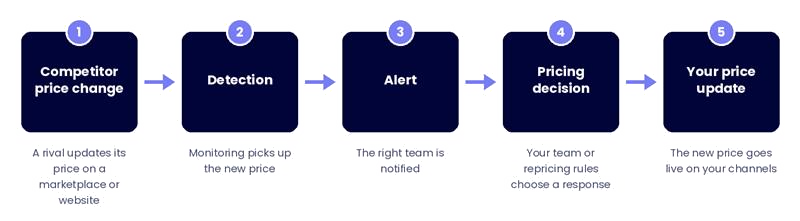
When every step moves at a similar pace, fresh data turns into faster price updates.
The best ROI comes from real-time monitoring for the products where speed determines whether the sale is made. Amazon’s Buy Box is a classic example. A premium skincare brand selling a vitamin C serum is able to maintain the Buy Box, as well as the sales that come with it, by matching a third-party seller’s lower price within minutes. Brands that do this well pair real-time data with price drop alerts and Smart Repricing rules that work within price limits the team has already approved. Routine matches happen automatically, and the pricing team can focus on bigger decisions.
Two questions show where real-time monitoring will help you most. How quickly does a competitor’s price change affect your sales? How quickly can your team respond? When both answers are in hours, real-time checks will pay for themselves. When either is in days, a daily schedule gives you everything you need.
Changing Your Monitoring Schedule Around Sales Events
Peak sales periods pack weeks of price movement into a few days, so it pays to check more often for a short stretch and then return to your usual schedule.
For example, an appliance manufacturer looking ahead to Cyber Week or Prime Big Deal Days would start increasing the frequency of monitoring of its hero air fryers and stand mixers around two weeks before the event, based on the initial discounts from early retailers and how low discounts are from each competitor. During the event, hero and core products move to the highest frequency, and MAP compliance checks run alongside them to catch resellers advertising below the agreed price.
In the week after, the team watches how quickly competitors raise prices again, which shows whether a discount was a one-off or the new normal. Once prices settle, checks go back to their regular pace. Our Q4 Pricing Intelligence Playbook covers the full holiday calendar.
What to Look For in a Price Monitoring Tool
Once you know the schedule you need, make sure your price monitoring tool can run it. These capabilities matter most for enterprise catalogs:
- Schedules by product group: Set different check frequencies for hero, core and long-tail products in one setup.
- Short-term changes for events: Raise check frequency for a sales period and switch back afterward without rebuilding anything.
- Accurate product matching: Every check is only as reliable as the match between a competitor’s listing and your SKU.
- Data where your team works: Updates reach dashboards, pricing systems or data feeds without manual exports.
How PriceIntelGuru Handles Different Monitoring Schedules
PriceIntelGuru gives enterprise pricing teams one platform to run every schedule covered in this guide. Competitor Monitoring tracks rival brand and retailer websites. Marketplace Monitoring follows sellers on Amazon, Walmart, Etsy, and eBay, and Google Shopping Monitoring shows how your products compare in shopping results. Teams can set check frequency for each part of the catalog, so hero products and long-tail lines each get the right level of attention.
Advanced AI Product Matching keeps every comparison like-for-like, with 99.2% accuracy across 10M+ products in 50+ countries. Compliance (MAP) Monitoring flags resellers' pricing below your policy, and Smart Repricing turns fresh competitor data into price updates within the rules you set. Our Price Intelligence Software delivers this data through SaaS dashboards, API or Data-as-a-Service, so it fits into the systems your pricing team already uses.
Final Thoughts
Checking every SKU on the same schedule leaves some products under-watched and others checked far more than they need. A better schedule starts with how prices behave, including how often they move, where the product sells, how competitors set prices and how often they run promotions. From there, sort products into tiers by how much they matter to the business. Real-time monitoring fits hero products where a price change affects sales within hours and your team can act just as fast. Core and long-tail items stay on daily or weekly checks, frequency goes up around peak sales periods, and a quarterly review keeps each product in the right tier.
Running that kind of schedule across a large catalog takes the right price monitoring tool and accurate product matching behind it. Connect with PriceIntelGuru’s pricing experts to build a monitoring schedule around your catalog, channels and sales calendar, and see how the right check frequency gives your team faster, more confident pricing decisions.


