




© 2025 PriceIntelGuru. All Rights Reserved
In 2026, the adoption of a highly advanced pricing intelligence solution will no longer be a matter of choice; it will be a matter of strategy. If there is no automatic monitoring in place, the retailers might end up in doing price war, lose their goods because of undercutting or miss the opportunity offered through discounts leading to a huge loss in revenue. A retailer who heavily relies on manual checks might have to devote several hours per week just for gathering the competitor's data, which is a time that can be utilized in strategizing pricing, planning promotions, and enhancing customer experience.
The present article will discuss the definition of price monitoring software, its importance for US e-commerce enterprises, major features to consider in 2026, and practical ways of implementation. Moreover, by the end of it, you will be aware of how to take advantage of AI-powered tools to keep up with the competitors, secure margins, and increase sales not just for the year 2026 but also for the years after that.
What is Price Monitoring Software?
E-commerce companies depend on price monitoring software to watch over the prices of their competitors. Live insights and forecasts would be available to you through modern tools, whereas you would have to rely on manual tracking for the opposite.
Benefits for US E-commerce Retailers:
- Real-Time Competitor Tracking: No longer revenue loss and fast reactions to the promotions.
- Predictive Pricing Analytics: Predict the most suitable prices according to the previous trends.
- Scalability Across Marketplaces: Manage Amazon US, Walmart.com, and Shopify US with a single dashboard.
- Data-Driven Decision Making: Speed up inventory turnover, preserve margins, and keep the competitive edge.
Why US E-commerce Businesses Need Price Monitoring
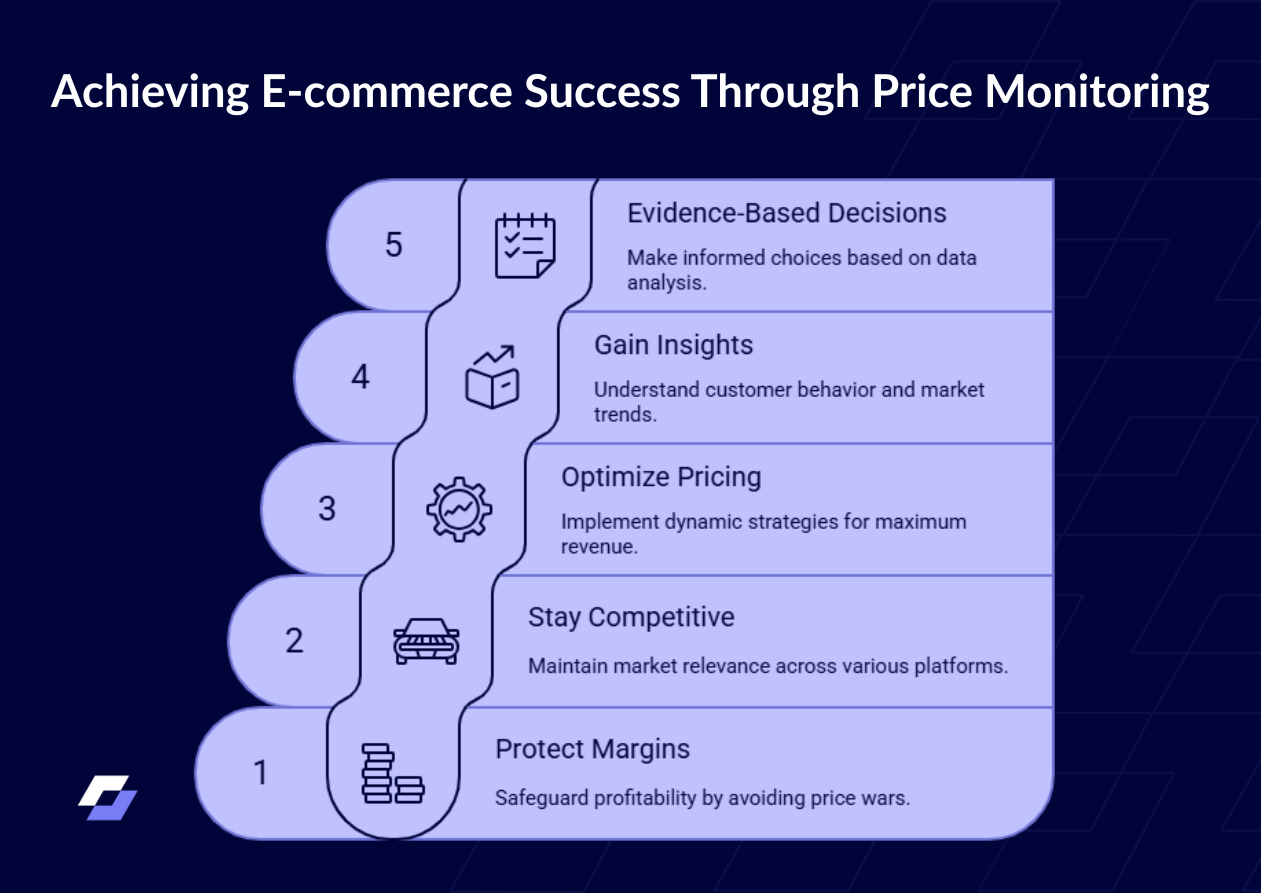
Price monitoring has more than just the purpose of keeping the competition in check; it has become a must-have type of strategy in 2026. The following are the main factors driving this:
1. Protect Margins and Avoid Price Wars
Automated monitoring plays an indispensable role in keeping discounting at a minimum and still allowing the profit margin to prevail.
2. Stay Competitive Across Marketplaces
Monitoring your prices ensures the competitiveness of your listings as Amazon US and Walmart.com are updating prices all the time.
3. Optimize Dynamic Pricing Strategies
Revenue increment of as much as 8% can result from dynamic price adjustments according to competitor activities, stock levels, and seasonal demand.
4. Gain Customer Insights
The retailer through his competitor analysis gets to know the customers better by knowing their preferences and the trends of the seasons.
5. Evidence-Based Decision Making
US retailers employing AI-driven pricing, according to KPMG’s Intelligent Retail Report (2025), are the winners in the competition with a revenue growth. (source)
Top Features to Look For in 2026
The US e-commerce retailers' choosing the correct price monitoring software is critical to remaining competitive and keeping profits in 2026. Here's a list of features that are necessary and the reasons for their importance:
1. Real-Time Alerts and Notifications
Responding to competitor pricing with a delay is not an option for retailers any longer. Real-time alerts make sure that you're instantly informed about the changes, reductions, or promotions in the prices of your products across the marketplaces such as Amazon US, Walmart.com, and Shopify US. A case in point is that a medium-sized electronics dealer saved money by not selling their best-selling items too cheap. This was possible because instant notifications were sent when competitors started flash sales, thus keeping a large part of their revenue intact.
2. AI-Powered Pricing Intelligence
Retailers can use predictive analytics to pinpoint the best prices by evaluating not only the competitors' actions but also the seasonal trends and historical sales. In 2026, AI can even forecast the movements in the market before competitors make their moves, giving the retailers a tactical advantage. To illustrate, a clothing brand was able to use AI pricing intelligence to raise the prices of summer collection just before the demand during the season, thus increasing their profitability by 8%.
3. Dynamic Pricing Automation
Automation helps in eliminating the chances of human errors and allows instant pricing modifications based on established rules. Whether it is a time-limited offer or pricing a product at par with a competitor, the use of automated solutions is always there to assist in revenue maximization while adhering to MAP and therefore not letting the brand value suffer.
4. Marketplace and POS Integration
A good price monitoring software integrates easily with different marketplaces and in-store POS systems. By having a centralized system, there is less manual work involved, and this assures that the prices are changed uniformly across the different sales channels. Retailers in the US who sell on platforms like Amazon, Walmart, or Shopify can take advantage of this automated synchronization which results in a reduction of operative costs.
5. Historical Trend Analysis
The analysis of historical data is a must for both demand forecasting and planning promotions. History-based tools give a detailed view to retailers which aids them in predicting price movements, improving sales strategies, and more importantly, avoiding excessive price cuts.
6. Multi-Currency Support
The multi-currency tracking for US retailers with overseas clientele guarantees the accuracy of global pricing. It allows for different pricing strategies worldwide, which is very important for the online retailing business as it continues to reach international markets.
7. Customizable Dashboards and Reports
The dashboards reveal briefly the revenue impact, pricing gaps of competitors, and the rate of inventory turnover, thus providing actionable insights. Retailers can through the customizable reports concentrate on the metrics that are the most relevant to their business objectives.
Real-World Use Cases
Electronics Retailer
- Problem: Prices of direct competitor Walmart.com, Amazon, and US changes so fast that the retailer often faced with revenue leakage. The manual monitoring of prices was very slow and error liable.
- Solution: AI-powered tool for real-time monitoring deployed over multiple marketplaces. It handled the tracking of hundreds of SKUs simultaneously and gave instant alerts to managers about any price change.
- Result: The leakage of revenue was lessened by 12% in three months. Offers were more in line with the behavior of competitors and retailer was able to remain in competition without sacrificing margins.
Fashion & Apparel Brand
- Problem: Demand for different seasons was impossible to predict and resulted in either too much stock or lost sales. The process of manual altering of prices was time-consuming and unproductive.
- Solution: A dynamic pricing tool was set up which took into account historical sales, competitor activity, and seasonal trends to set the best prices.
- Result: An 8% improvement in profit margins, and quick turnover of inventory, along with customer satisfaction due to pricing that was competitive and in sync with demand.
Automotive Parts Supplier
- Problem: The company was burdened with heavy manual work for tracking their competitors, which not only consumed a lot of staff time but also posed the risk of errors. It was hard to keep MAP (Minimum Advertised Price) compliance.
- Solution: Automated monitoring was introduced, and it was integrated with the POS (Point of Sale) and marketplaces. The system detected price differences and recommended changes using AI analytics.
- Result: 60% of the time spent on manual monitoring was saved, MAP compliance was maintained, and the company became more responsive to market changes.
Key Takeaways:
- AI technology based monitoring cuts down on both manual labor and mistakes.
- Pricing that changes with the market improves income and cuts down on stock holding.
- The use of automated alerts guarantees that the pricing is competitive without losing the brand's value.
How to Implement a Price Monitoring Strategy
Step 1 – Identify Competitors & SKUs
First, make a list of the company's direct competitors all across the US marketplaces, even including online and small sellers. Focus on high-margin products, seasonal items, and best-sellers. This way, the monitoring resources will be directed to those products which have the biggest impact on revenue.
Step 2 – Select the Right Tool
Pick a software that uses AI for analytics, supports automation, and integrates with marketplaces. Besides, predictive pricing, automated alerts, and customizable dashboards are some features you can expect the tool to possess. Confirm that the tool can monitor your sales channels in the US and connect with in-store POS systems if necessary.
Step 3 – Configure Alerts & Automate Updates
Determine the amount of price reductions based on margin, demand, and competitor activity. To keep pricing uniform across all marketplaces and avoid losing revenue, automate updates. For instance, setting alerts for flash sales guarantees that there will be immediate response to competitor promotions.
Step 4 – Analyze & Adjust Regularly
Review the pricing metrics every week or every month to determine if they are working well or not. Study the trends of the competitors, their stock levels, and the effects of their promotions. Therefore, make the necessary adjustments to the pricing strategies. Remember the learned things and apply them to future campaigns so that the revenue and margin performance can be optimized continuously.
Pro Tips:
- Start with top SKUs to prevent monitoring overload.
- Use AI insights to anticipate competitor moves.
- Maintain MAP compliance while adjusting prices dynamically.
Common Mistakes to Avoid
1. Over-Discounting Products
Retailers usually cut prices significantly to keep up with competitors, thus losing both margins and the brand's good image. It is better to use dynamic pricing tools to make adjustments that are competitive but at the same time revenue-friendly. For instance, a US clothing retailer that used AI-driven pricing for replacing manual markdowns was able to decrease unnecessary discounts by 15%.
2. Relying on Manual Tracking
Monitoring competitors manually takes a lot of time and at the same time is very easy to make errors. Automated tools help staff save hours and bring real-time accuracy, which is very important to create marketplaces with constant price changes such as Amazon US.
3. Ignoring Real-Time Alerts
A slow reaction to the competitors' price changes can result in a revenue loss. Setting up automated notifications can provide you with instant visibility and the opportunity to act.
4. Not Aligning Pricing with Brand Positioning
Pricing is a reflection of value perception. If a product is undersold, it will lose its credibility with the customers, and if it is overpriced, it will drive the customers away. Data-driven insights can be used to find a balance.
5. Neglecting Data Analysis
Not analyzing the trends will result in retailers not being able to make well-informed pricing decisions. Regularly going through the historical and competitive data is helpful in making the strategy effective.
Mini Example: A US electronics retailer was so focused on competitor alerts that it ended up giving away 5% of its revenue during one quarter because of underpricing. With the use of automated alerts and AI analysis corrected this, demonstrating the importance of data-driven monitoring
Conclusion
In 2026, US e-commerce retailers must adopt AI-driven price monitoring software to remain competitive, protect margins, and optimize revenue. With real-time insights, predictive analytics, and dynamic pricing, businesses can respond instantly to market changes.
Request a Demo – Experience real-time competitor tracking.