






© 2025 PriceIntelGuru. All Rights Reserved
Picture a brake-pad manufacturer that sells to regional distributors, supplies independent repair shops, and lists the same part on Amazon. Each of those buyers sees a different price, and each price has to cover cost and still leave room for profit. Get the wholesale number wrong, and distributors either push back or squeeze your margin. Get the retail number wrong, and the part sits on the shelf while a competitor listing wins the sale.
Whether you sell resellers, to end customers, or both, understanding wholesale vs. retail price is what keeps every channel profitable. Below is a practical breakdown of how each price is built, the formulas behind them, and the mistakes that quietly erode margins.
What Is Wholesale Price?
Wholesale price is the amount a manufacturer charges for retailers, distributors, or resellers for bulk purchases. Because buying in volume means the manufacturer moves inventory faster and reduces per-unit selling costs; that price sits below what a shopper eventually pays. The manufacturer still needs to cover production, labor, and overhead while building a fair profit, and the buyer expects a discount in exchange for committing a large order before it has actually sold.
For the seller, wholesale trades margin for certainty. A distributor that commits 500 units takes on the inventory risk, ties up its own cash, and handles last-mile sales. The lower per-unit price is what the seller pays for moving volume without carrying that risk itself.
What Is Retail Price?
The retail price is what the end buyer pays, whether that’s a car owner at a repair shop, a contractor at a building-supply counter, or a shopper on a marketplace. Resellers add a markup to their wholesale cost to cover rent, staff, marketing, and profit. The same product can carry very different retail prices depending on the channel: a part sold through a dealer with service bundled in costs more than the same part on a marketplace, where fees are lower, and price comparison is one click away.
Wholesale Price vs Retail Price: What's the Real Difference?
The core distinction comes down to who is paying, and what costs are baked into that number. One reflects a manufacturer's production economics plus a modest margin built for volume. The other reflects a full retail operation cost plus a markup built for a single-unit sale. Neither number is arbitrary. Both come from the same starting point: total cost.
Components of Any Pricing Strategy
Whether you are setting a bulk rate or a shelf price, the logic is identical: you need to know exactly what it costs you to produce and deliver one unit.
The cost of Goods Sold (COGS) is the starting point. It covers:
- Raw materials and components
- Labor and production wages
- Manufacturing costs
- Packaging, labels, and tags
Overhead costs come next, covering everything that keeps the business running behind the scenes:
- Rent and utilities for a warehouse, store, or office
- Software subscriptions and website hosting
- Shipping and fulfillment
- Storage and warehousing fees
- Staff salaries and insurance
To find overhead per unit, divide total monthly overhead by the number of units produced or sold in that period.
Markup vs Margin: Why the Distinction Matters
These two terms get confused constantly and mixing them up leads to underpricing. Markup is the percentage added on top of cost. Margin is calculated from the selling price itself. A 50% markup on a $100 product means selling it for $150, but that same $150 sale only produces a 33% profit margin, not 50%.
Markup = (Selling Price − Cost) ÷ Cost × 100
Margin = (Selling Price − Cost) ÷ Selling Price × 100
Getting this backward is one of the fastest ways to quietly underprice an entire catalog.
How to Calculate Wholesale Price
Start by totaling your true cost per unit, then decide the minimum profit that keeps the business healthy. That number, not a percentage, is what completes the wholesale pricing formula:
Wholesale Price = Materials + Labor + Overhead + Desired Profit per Unit
Back to the brake-pad set. Materials cost $14, labor $5, and allocated overhead $3, for a total cost of $22 per set. Add a target profit of $8 and the wholesale price is:
$14 + $5 + $3 + $8 = $30
This approach, known as absorption pricing or full costing, makes sure every unit covers both variable and fixed costs instead of pricing raw materials alone. Tracking wholesale profit margin over time also flags when a bulk discount has quietly gone too deep.
How to Calculate Retail Price
The reseller starts from what it paid, the wholesale price, and has two ways to get to retail:
Markup method: Retail = Wholesale × (1 + Markup)
$30 × 1.60 = $48
Margin method: Retail = Wholesale ÷ (1 − Target Margin)
For a 40% margin: $30 ÷ 0.60 = $50
The margin method is safer when you report profitability as a percentage of sales, because it hits the target exactly.
The Keystone Pricing Method
Keystone pricing simply doubles the cost or bulk rate to set the number a customer sees, producing a straightforward 50% margin. For a reseller, the rule is:
Retail Price = Wholesale Price × 2
A phone charger bought at $12 wholesale is key stoned to $24. If three competitors list the same charger at $19.99 on Amazon, though, the keystone price won’t sell. Treat keystone as a starting point and check it against live market prices before you commit.
Manufacturer's Suggested Retail Price (MSRP)
MSRP is the number a manufacturer recommends retailers sell at. Staying near that figure protects brand consistency across resellers, though retailers can still adjust within reason based on their own costs and market conditions. Pricing across a network of resellers is also an area for regulators to watch closely. The Federal Trade Commission enforces rules requiring that manufacturers and wholesalers provide advertising allowances and other promotional payments to retailers on proportionally equal terms, so consistency in how discounts and allowances are extended across a reseller network matters both commercially and legally.
MSRP is a recommendation; MAP (Minimum Advertised Price) is an enforceable policy on the lowest price a reseller can advertise. Brands use compliance monitoring to catch MAP violations early.
Pricing Strategies That Protect Wholesale and Retail Margins
Value-based pricing sets the price around what a customer believes the product is worth, not just what it costs to make. A strong brand and clear differentiation make this approach work.
Tiered (volume) pricing rewards bigger orders. An auto-parts supplier might sell automotive screws at $12 per box of 100 for up to 49 boxes, $11 for 50–199 boxes, and $10 for 200 or more. Every tier still covers cost, and repair shops have a reason to order more at once.
Competitive pricing anchors your price to what similar products sell for. It matters most in categories like electronics and marketplaces, where buyers compare prices instantly.
Many teams also default to cost-plus pricing, simply adding a fixed percentage on top of cost. It is easy to apply consistently, though it ignores what competitors charge and what customers are willing to pay, which is why it works best as a starting point rather than a final answer.
Common Pricing Mistakes to Avoid
Pricing from wholesale cost instead of landed cost: An industrial bearing bought at $40 looks like a 50% markup when sold at $60. Add $5 in freight and duties, and the real margin is 25%.
Using one markup across every channel: Marketplace fees, dealer discounts, and direct sales each change the math, so a single blanket markup underprices some channels and overprices others.
Treating prices as fixed: Demand and competitor prices move. A 1 percent price increase can translate into roughly an 8.7 percent increase in operating profit, assuming volume holds steady, so regular, small price tests are worth running.
Retail Pricing Statistics You Should Know
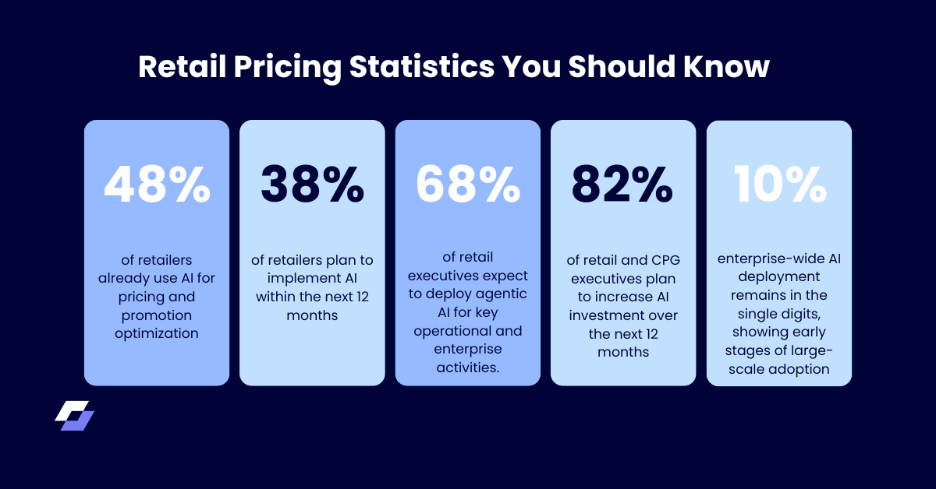
AI is rapidly transforming how retailers manage pricing, promotions, and customer experiences. Recent industry research highlights the growing adoption of AI across retail operations.
- 48% of retailers already use AI for pricing and promotion optimization, while 38% plan to implement it within the next 12 months.
- 68% of retail executives expect to deploy agentic AI for key operational and enterprise activities within the next 12–24 months.
- 82% of retail and CPG executives plan to increase AI investment over the next 12 months, although most are still in the early stages of scaling AI across the business.
- Despite strong investment, enterprise-wide AI deployment remains in the single digits (10%), showing that many retailers are still moving from pilot projects to large-scale implementation.
How PriceIntelGuru Helps Get the Number Right
Manual calculations work fine for a handful of SKUs. They break down fast once a catalog scales across channels, regions, or reseller networks. PriceIntelGuru is built to close that gap. The platform monitors 10 million-plus products across more than 50 countries, matching identical or comparable items with 99.2% advanced AI product matching accuracy, so pricing teams are always comparing apples to apples.
Rather than manually re-running formulas every time a competitor moves, brands running on PriceIntelGuru's advanced AI dynamic pricing feature see pricing adjust automatically based on real market movement, protecting margin without constant manual oversight. Clients across FMCG, automotive parts, electronics, and travel have reported 15 to 30% margin improvement and 28% faster revenue growth after putting real pricing data behind their decisions instead of guesswork.


