





© 2025 PriceIntelGuru. All Rights Reserved
Marketplace price monitoring is the practice of tracking competitor prices, promotions, and stock levels across online marketplaces in real time to inform pricing decisions. It matters now more than ever: more than half of retailers worldwide (53%) say consumers are increasingly price-sensitive, and 57.4% of small and mid-sized businesses report that customers have become more price-sensitive than they were a year ago. Any brand selling on Amazon, Walmart, Target, eBay, or Shopify is competing in a landscape where prices change by the hour.
Ecommerce brands, retailers, and manufacturers all need visibility into this shifting pricing landscape. Without Marketplace price monitoring software, pricing teams are stuck checking competitor listings manually, a process too slow to keep pace with marketplace algorithms. With competitor price monitoring and AI-powered pricing, businesses can react in minutes instead of days, protecting margin while staying competitive on the marketplaces that matter most to their customers.
This guide covers how marketplace price monitoring works, why it matters in 2026, what to look for in a platform, and how AI is reshaping the entire pricing intelligence category.
What Is Marketplace Price Monitoring?
Marketplace price monitoring is the continuous, automated process of collecting competitor pricing, availability, and promotional data from online marketplaces and translating it into actionable pricing decisions. It relies on online price monitoring technology to track listings, competitor price tracking to flag changes, and pricing intelligence to turn raw data into strategy.
Manual monitoring means a pricing analyst checking competitor listings by hand, copying prices into spreadsheets, and updating them once a day or once a week at best. It does not scale past a handful of SKUs and competitors, and it cannot catch a flash sale that lasts six hours. Automated monitoring uses software to crawl marketplace listings around the clock, match products across sellers using AI, and surface price changes the moment they happen.
The difference is speed and scale. A manual process might review 200 SKUs once a week. An automated platform can monitor tens of thousands of SKUs across dozens of marketplaces continuously, which is the baseline expectation for any brand competing on Amazon or Walmart today.
Why Marketplace Price Monitoring Matters in 2026
Marketplace price monitoring matters in 2026 because shoppers are more price-sensitive, marketplaces are more competitive, and AI-driven dynamic pricing has become standard practice among large retailers. Brands without monitoring in place are effectively pricing blinds against competitors who are not.
Several forces are converging to make this urgent:
- Consumer behavior has shifted. Deloitte's research finds that four in 10 Americans now demonstrate deal-driven or cost-conscious behavior, actively comparing prices before purchasing. Deloitte's 2026 Retail Industry Global Outlook breaks down how this value-seeking mindset is reshaping retail strategy this year.
- Dynamic pricing has a measurable upside. McKinsey's work with retail and consumer clients shows dynamic pricing approaches can drive sales growth of 2 to 5 percent and margin increases of 5 to 10 percent. McKinsey's Dynamic E-commerce Pricing practice overview outlines the approach behind those figures.
- Ecommerce keeps growing. Global retail ecommerce sales are forecast to reach $6.88 trillion in 2026, a 7.2% increase from the previous year, meaning more competitors and more listings to track.
- AI adoption is accelerating but still uneven. Many retailers still rely on rule-based repricing that reacts to a single signal at a time, leaving room for AI-powered platforms to capture share from slower-moving competitors.
For brands selling across Amazon, Walmart, Target, eBay, and Shopify, this combination of price-sensitive shoppers and AI-equipped competitors means pricing strategy can no longer be a quarterly exercise. It needs to be continuous.
How Marketplace Price Monitoring Works
Marketplace price monitoring works through a structured pipeline: crawling marketplace listings, matching products to the correct competitor SKU, extracting price and stock data, cleaning that data for accuracy, running analytics, and triggering alerts or dashboards for the pricing team.
- Crawl marketplaces. Automated crawlers scan product listings across target marketplaces on a defined schedule, often hourly or in near real time for high-priority SKUs.
- Product matching. AI product matching and machine learning models match listings to the correct product across different sellers, titles, and images, since the same item is rarely listed identically across marketplaces.
- Price extraction. The system pulls price, shipping cost, promotional discounts, and stock status from each matched listing.
- Data cleaning. Raw data is deduplicated and validated to remove bundle listings, refurbished items, or mismatched products that would distort pricing decisions.
- Analytics. Cleaned data feeds into pricing analytics that surface trends, margin impact, and competitive positioning by category or SKU.
- Alerts and dashboards. Pricing teams receive real-time alerts on price changes, MAP violations, or stockouts, with dashboards summarizing the broader competitive landscape.
Automation and AI are what make this workflow viable at scale. A platform monitoring thousands of SKUs across dozens of marketplaces simply cannot rely on manual review at any stage of this pipeline.
Benefits of Marketplace Price Monitoring
Beyond these direct gains, consistent monitoring builds a historical record of pricing behavior across the market, which becomes valuable for forecasting promotions, planning seasonal pricing, and negotiating with suppliers or marketplace partners.
Key Features to Look for in Marketplace Price Monitoring Software & Tool
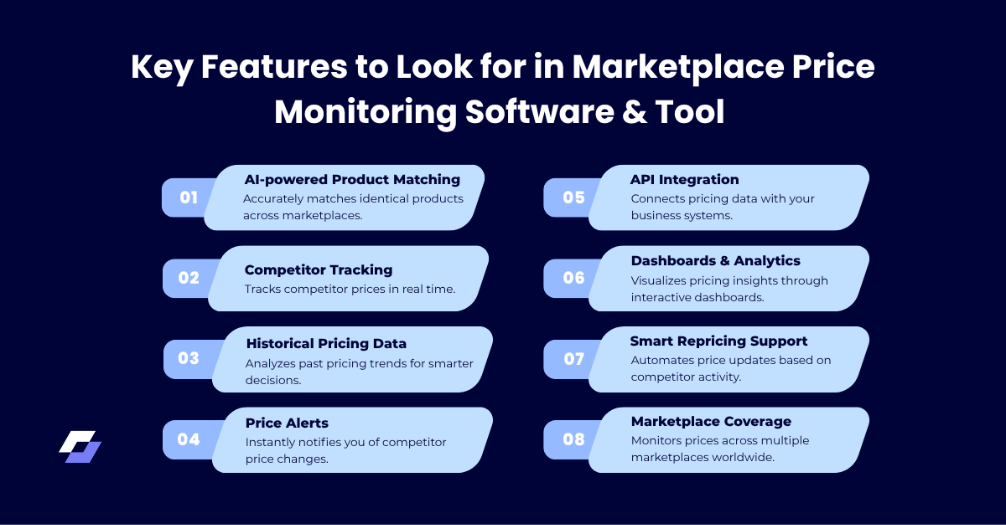
The strongest marketplace price monitoring software combines accurate product matching, broad marketplace coverage, and data you can act on immediately rather than data that requires hours of manual cleanup.
- AI-powered product matching: Matches listings across sellers and marketplaces even when titles, images, or variants differ.
- Competitor tracking: Monitors specific competitor sellers and brands, not just generic category pricing.
- Historical pricing data: Stores past pricing trends to support forecasting and promotional planning.
- Price alerts: Notifies pricing teams instantly when a competitor changes price, runs a promotion, or violates MAP policy.
- API integration: Connects monitoring data directly into ERP, PIM, or repricing systems.
- Dashboards and analytics: Visualizes pricing trends and competitive positioning without manual spreadsheet work.
- Smart Repricing support: Some platforms extend monitoring data into automated repricing rules, adjusting prices based on competitor moves and margin thresholds.
- Marketplace coverage: Supports the specific marketplaces a brand sells, ideally across multiple countries.
Top Marketplaces Businesses Should Monitor
Coverage should match where a brand's actual customers shop and compare prices, not just the largest marketplaces by overall volume.
Industries That Benefit from Marketplace Price Monitoring
Marketplace price monitoring applies wherever products are sold across multiple online channels, and price comparison influences purchase decisions. That spans far beyond general retail.
1. Retail and consumer electronics
Where price comparison shopping is the norm, and margins are thin. Shoppers routinely check out Amazon, Best Buy, and Google Shopping side by side before buying, so even small price gaps can shift a sale to a competitor. Fast product cycles and frequent new releases make continuous tracking essential here.
2. Fashion and beauty
Seasonal pricing and frequent promotions require constant tracking. Collections rotate quickly; flash sales and influencer-driven discounts happen with little notice, and shoppers expect competitive pricing during key shopping windows like back-to-school and holiday season. Brands that miss a competitor's promotion risk losing share during the exact moments that drive the most volume.
3. Home goods
Wayfair and similar marketplaces drive category-wide price benchmarking. Furniture, decor, and appliance pricing tend to vary widely by bundle, shipping cost, and seasonal demand, so accurate product matching is critical to avoid comparing mismatched configurations or bundled offers.
4. Grocery
Regional pricing and rapid promotional cycles demand near-real-time monitoring. Prices often differ by zip code, store format, and local competition, and weekly circulars or app-based deals can change multiple times within a single sales cycle, making manual tracking nearly impossible at scale.
5. Automotive parts
MAP compliance and authorized seller pricing are common challenges. Manufacturers frequently sell through a network of authorized dealers and third-party marketplace sellers, which creates ongoing risk of unauthorized discounting that undercuts brand value and dealer relationships if left unmonitored.
6. Manufacturing and industrial parts
B2B buyers increasingly compare prices online before purchasing. Even in traditionally relationship-driven sales cycles, procurement teams now research list prices and distributor pricing online, so manufacturers benefit from understanding how their pricing compares across distributor and marketplace listings.
7. Pharmaceutical and healthcare products
Pricing accuracy and compliance carry regulatory weight. Over-the-counter health products and medical supplies sold through marketplaces require careful monitoring not just for competitiveness, but to catch unauthorized sellers or pricing inconsistencies that could raise compliance concerns.
8. Travel and online travel agencies (OTAs)
Fare and rate parity across booking channels directly affect conversion. Hotels, airlines, and travel platforms depend on rate parity to protect both direct bookings and OTA relationships, and even small discrepancies across channels can trigger lost bookings or contractual disputes.
9. B2B commerce
Where buyers research competitor pricing even outside traditional consumer marketplaces. As B2B purchasing increasingly mirrors consumer shopping habits, businesses that sell through online catalogs or quote-based portals benefit from understanding how their pricing positions against competitors, even when transactions ultimately happen offline.
Marketplace Price Monitoring vs Competitor Price Monitoring
In practice, most brands need both. Marketplace price monitoring keeps pricing competitive where the bulk of transactions happen, while competitor price monitoring provides the wider strategic picture across every channel a rival operates in.
Common Pricing Challenges Businesses Face
- Price wars: Aggressive undercutting between sellers that erodes margin across an entire category
- Unauthorized sellers: Third parties listing products outside approved channels, often at inconsistent prices
- MAP violations: Sellers pricing below the minimum advertised price, undermining brand value and authorized retailer relationships
- Stock fluctuations: Prices shifting in response to inventory levels, sometimes faster than manual processes can track
- Regional pricing differences: Managing consistent value perception across markets with different costs and currencies
- Marketplace volatility: Algorithmic repricers on competing listings that adjust prices multiple times a day
- Product matching errors: Misidentifying competitor SKUs, which leads to pricing decisions based on the wrong comparison product
How AI Is Transforming Marketplace Price Monitoring
AI is transforming marketplace price monitoring by replacing manual data collection and matching machine learning models that operate continuously and at a far greater scale than human teams.
Machine learning models learn from historical pricing patterns to predict competitor behavior and recommend pricing adjustments. Computer vision matches products across listings using product images, catching matches that text-based matching alone would miss.
Natural language processing (NLP) parses product titles and descriptions to identify true matches despite inconsistent naming conventions across sellers. Predictive analytics forecasts how competitors are likely to respond to promotions or price changes, supporting proactive rather than reactive pricing.
AI-driven recommendations suggest specific price points based on margin targets, competitive position, and demand signals. Automated product matching is the foundation that makes all the above reliable, since accurate matching determines whether downstream pricing decisions are sound. Generative AI is increasingly used to summarize pricing trends and competitive shifts in plain language, making pricing intelligence accessible to non-technical stakeholders.
Together, these capabilities are why McKinsey-cited figures put only about 15 to 20% of retailers with any dynamic-pricing capability as of 2024, while roughly 63% of retailers reportedly use predictive analytics to inform pricing. The gap between basic analytics and true AI-powered repricing remains a real opportunity for brands willing to invest in the technology.
Best Practices for Effective Marketplace Price Monitoring
Effective marketplace price monitoring starts with monitoring pricing daily at minimum, with real-time tracking on high-velocity SKUs and competitive categories, since these are the products most likely to shift in price without warning. It also means tracking multiple marketplaces simultaneously rather than relying on a single channel for competitive signals, because a brand that only watches Amazon will miss pricing moves happening on Walmart, Target, or eBay that still influence overall demand.
Just as important is maintaining historical pricing data to identify seasonal trends and recurring promotional patterns, which helps pricing teams anticipate competitor behavior instead of simply reacting to it. Promotions and discount events should be tracked specifically, since list price alone does not reflect real competitive pricing and can give a misleading picture of where a brand stands.
Automation should handle data collection and matching, reserving human judgment for strategic pricing decisions that require business context AI cannot fully account for. Before enabling any automated repricing, businesses should set clear pricing rules and margin thresholds, so automation operates within guardrails rather than making unsupervised decisions.
Finally, integrating pricing data into existing BI dashboards ensures pricing intelligence sits alongside other business metrics, giving leadership a unified view rather than a siloed pricing report disconnected from the rest of the business.
Real-World Use Cases by Industry
1. Retail brand
Selling across Amazon and its own Shopify store can use marketplace price monitoring to ensure its direct-to-consumer pricing stays competitive with its own marketplace listings, avoiding channel conflict that confuses shoppers.
2. Manufacturer
Distributing through multiple authorized retailers can monitor MAP violations across those retailers' marketplace listings, protecting brand value and retailer relationships without manually checking every listing.
3. Distributor
Managing thousands of SKUs across B2B and B2C channels can use product matching and historical pricing data to identify which categories are most exposed to price erosion and prioritize monitoring accordingly.
4. Marketplace seller
Competing primarily on Amazon or Walmart can use real-time alerts to respond to competitor price drops within the buy box window, protecting sales velocity without sacrificing margin unnecessarily.
5. Consumer electronics brand
Facing fast-moving price wars on new product launches can track competitor pricing hourly during the critical first weeks after release, when price positioning has an outsized impact on early sales momentum.
6. Fashion retailer
Managing seasonal markdowns can use historical pricing analytics to time discounts more precisely. Avoiding premature markdowns that erode margin before demand requires a price cut.
How PriceIntelGuru Helps Businesses Monitor Marketplace Prices
PriceIntelGuru is built specifically for the workflow described throughout this guide. The platform combines AI-powered product matching, real-time competitor tracking, and historical pricing analytics into a single system that pricing teams can act on without manual data wrangling.
Product matching is the foundation of reliable pricing intelligence, and PriceIntelGuru delivers 99.2% product matching accuracy, which means pricing decisions are based on comparisons to the correct competitor SKU rather than a mismatched substitute. Coverage spans more than 50 countries, supporting brands that compete across multiple regional marketplaces rather than a single domestic channel.
Beyond monitoring, PriceIntelGuru's Smart Repricing capability turns competitive pricing data into automated pricing actions, governed by the margin rules and thresholds a business set. Customers using the platform have seen 15 to 30% margin improvement and 28% faster revenue growth, driven by faster, more accurate pricing decisions across their marketplace presence.
Custom dashboards give pricing, marketing, and merchandising teams shared visibility into competitive positioning, while API integration connects this intelligence directly into existing ERP, PIM, or repricing systems. The result is a single source of pricing truth across SaaS, DaaS, and API delivery models, built for high-volume, multi-vertical retail teams managing complex marketplace portfolios.
Conclusion
Marketplaces will keep changing rapidly, with new sellers, new promotions, and new AI-driven repricers entering the competitive landscape every day. Businesses that invest in AI-powered marketplace price monitoring gain faster pricing decisions, higher profits, stronger competitive positioning, and a better overall customer experience built on prices that reflect real market conditions rather than guesswork.
For brands ready to move beyond manual spreadsheets and into real-time, AI-driven pricing intelligence, PriceIntelGuru's marketplace price monitoring platform is built to support that shift. Book a demo now.